Take a Peak.
Here is a preview of available materials on The Speech Shelf. New materials are added monthly!
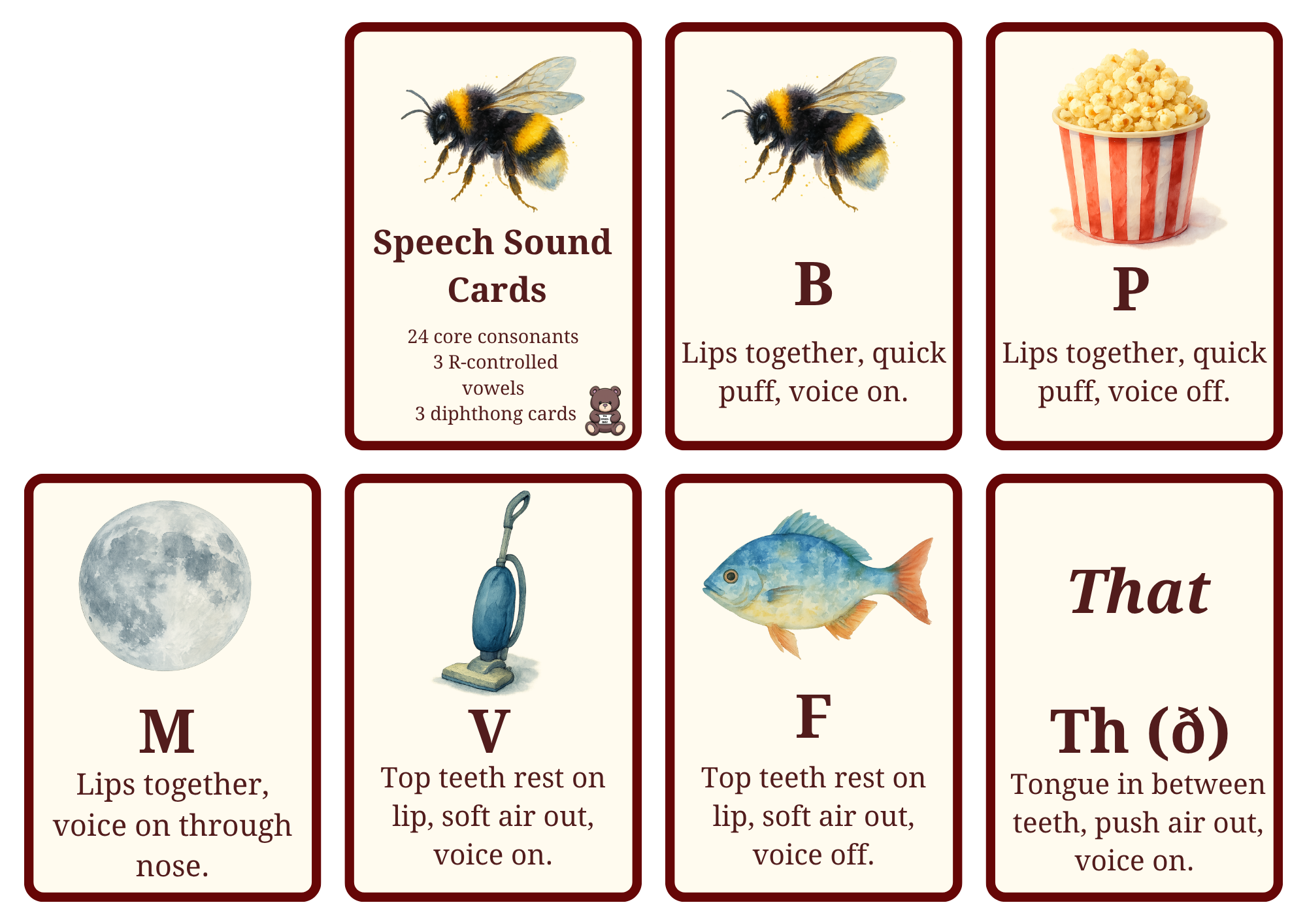
Speech Sound Cue Cards
This set includes 24 core consonant cards, 3 R-controlled vowel cards, and 3 diphthong cards, each paired with a soft watercolor illustration and a simple, child-friendly cue. Perfect for therapy or home practice, they support consistent articulation learning in a calm, confidence-building way.
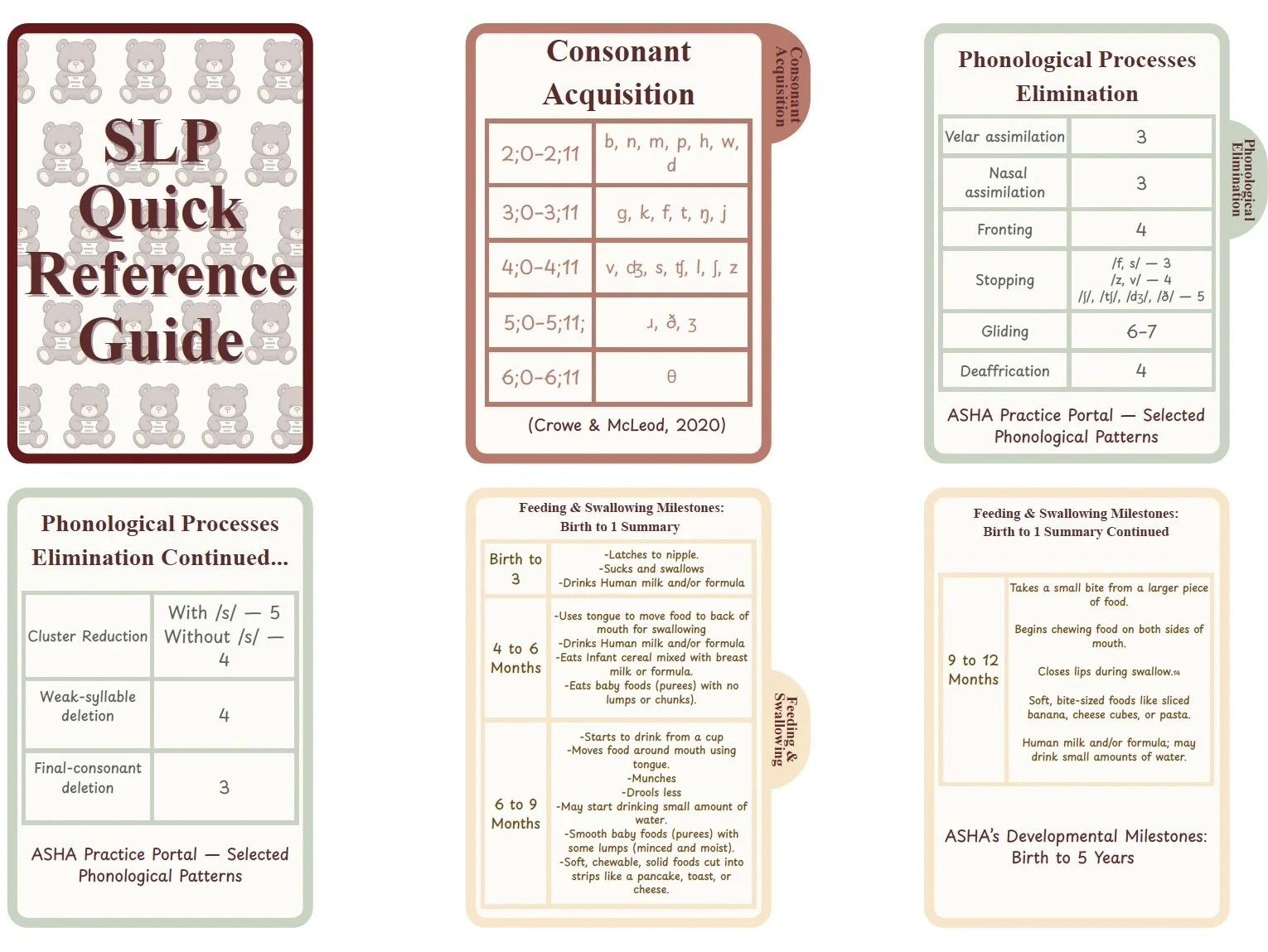
SLP Quick Reference Guide
Includes:
Phonological Process Elimination Chart – ages of suppression, clearly organized. ASHA align
Feeding & Swallowing Milestones – from birth to 12 months, ASHA and CDC-aligned.
Speech Sound Development (Crowe & McLeod, 2020) – updated consonant acquisition norms.
Common ICD-10 & CPT Codes – verified through ASHA for speech, language, voice, and feeding.
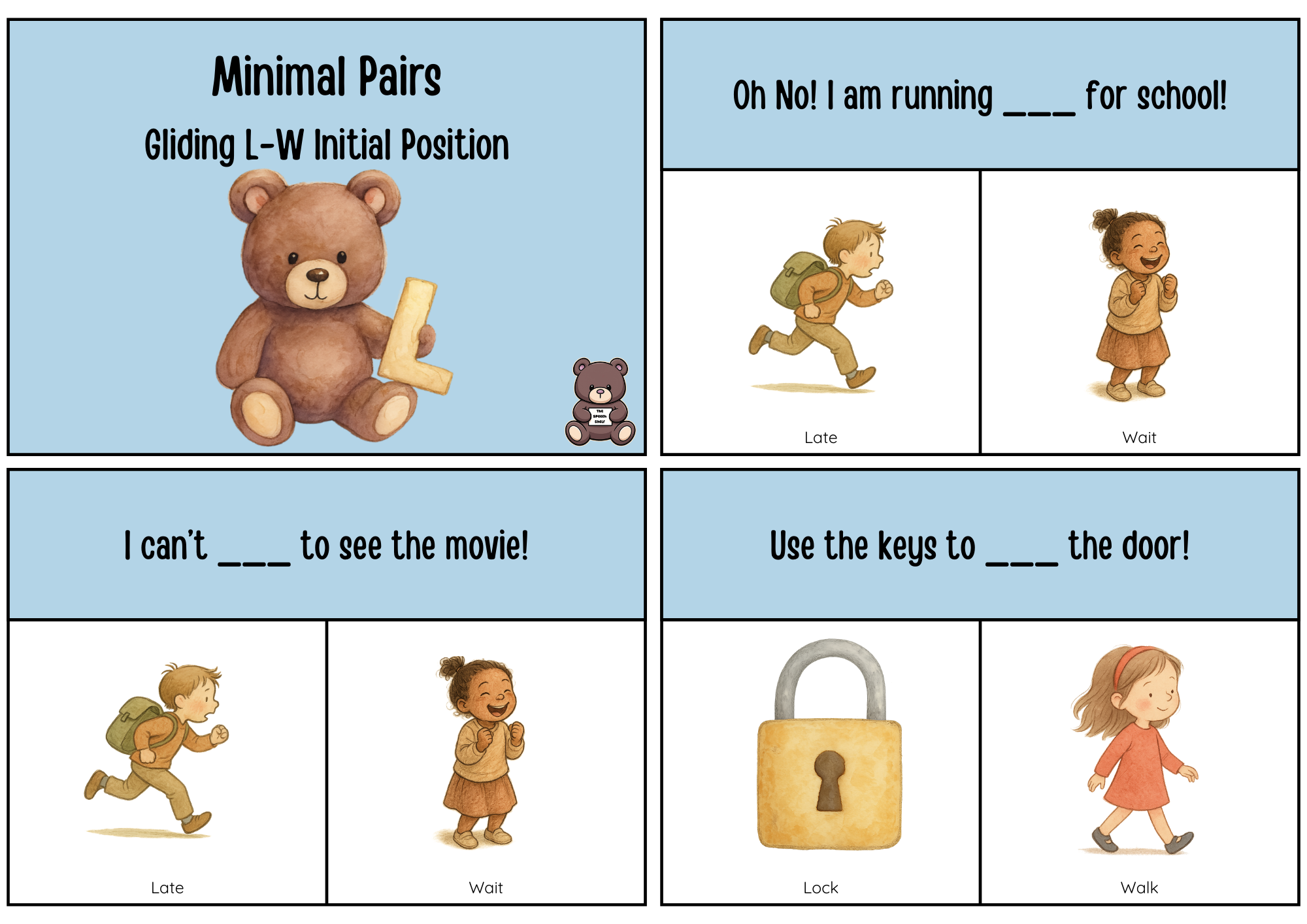
Minimal Pairs Cards Gliding L-W Initial Position
This interactive minimal pairs activity targets gliding of /l/ to /w/ in the initial word position, using high-quality watercolor illustrations to support speech perception and production. Students are presented with picture-supported phrases and must choose the correct minimal-pair target (e.g., late–wait, lock–walk, lake–wake, light–white).
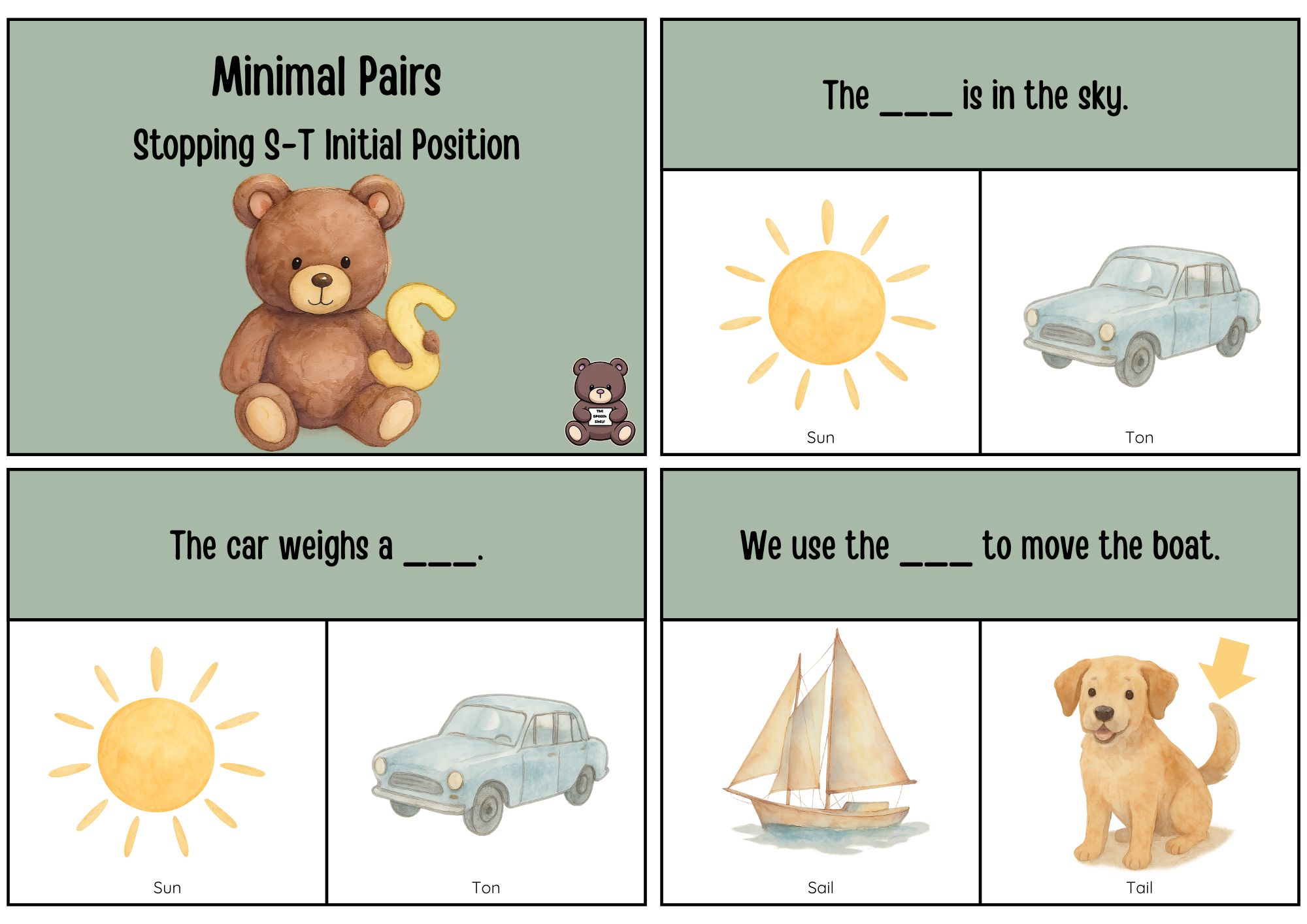
Minimal Pairs Cards Stopping S-T Initial Position
This interactive minimal pairs activity targets stopping of /s/ to /t/ in the initial word position, using high-quality watercolor illustrations to support speech perception and production. Students are presented with picture-supported phrases and must choose the correct minimal-pair target (e.g., sun–ton, sail–tail, sight–tight, sue–two, sock–talk, sub–tub, sip–tip, sick–tick).
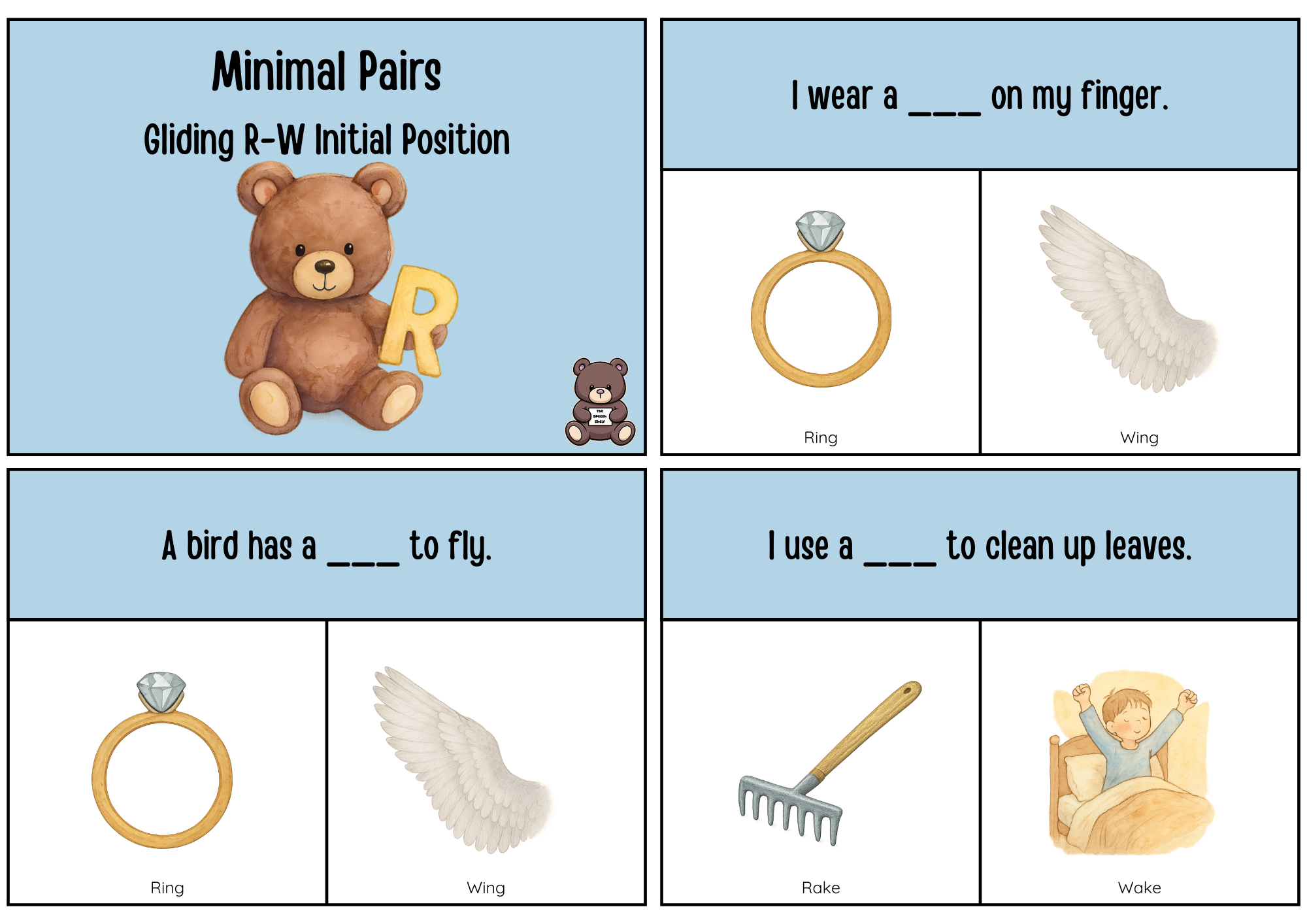
Minimal Pairs Cards Gliding R-W Initial Position
This interactive minimal pairs activity targets gliding of /r/ to /w/ in the initial word position, using high-quality watercolor illustrations to support speech perception and production. Students are presented with picture-supported phrases and must choose the correct minimal-pair target (e.g., ring–wing, rake–wake, rich–witch, run–one, read–weed, rock–walk, right–white).
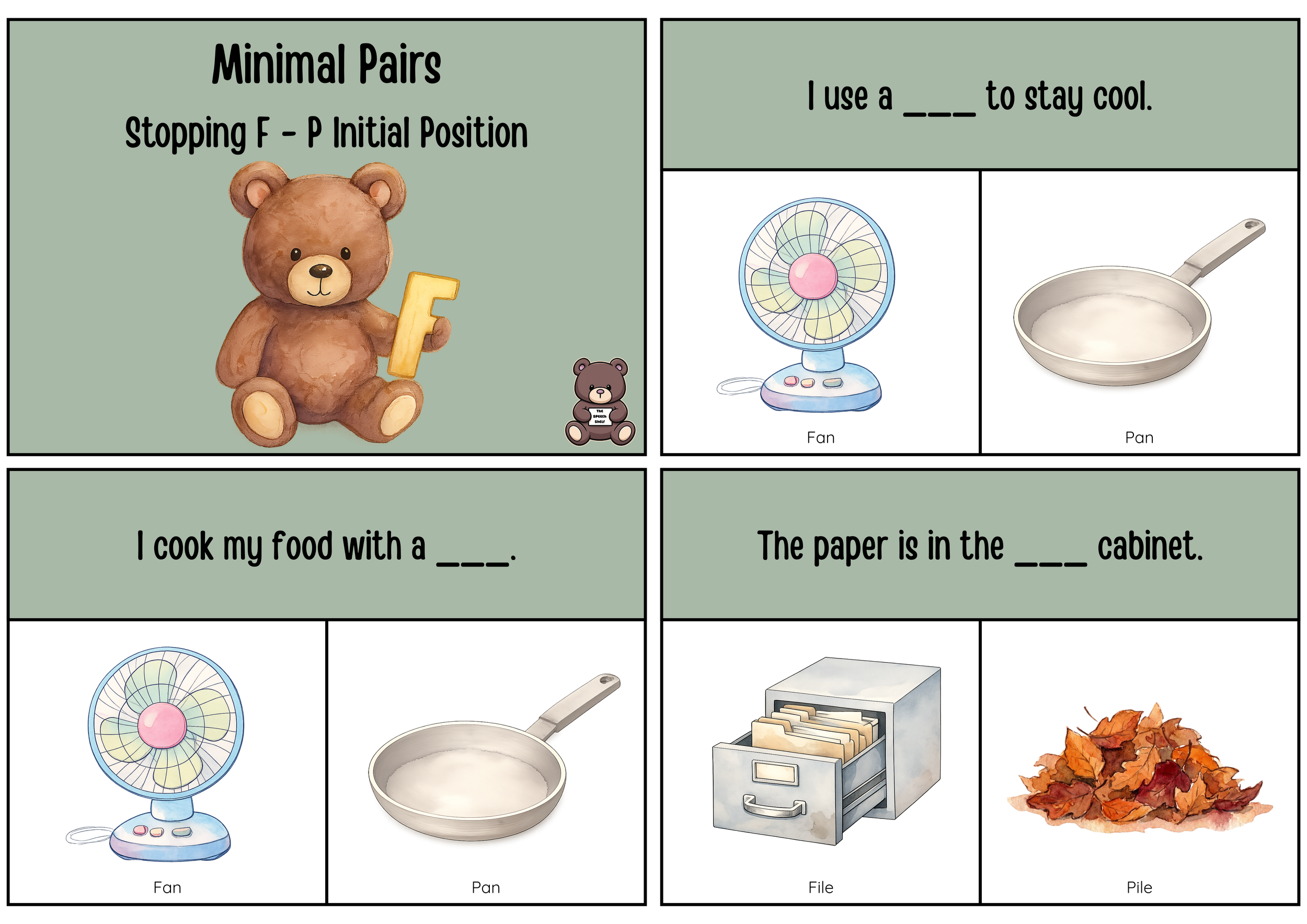
Minimal Pairs Stopping F-P Initial Position
This interactive minimal pairs activity targets stopping of /f/ to /p/ in the initial word position, using high-quality watercolor illustrations to support speech perception and production. Students are presented with picture-supported phrases and must choose the correct minimal-pair target (e.g., fan–pan, file–pile, four–pour, fair–pear, feet–Pete, fin–pin, face–pace, full–pull).
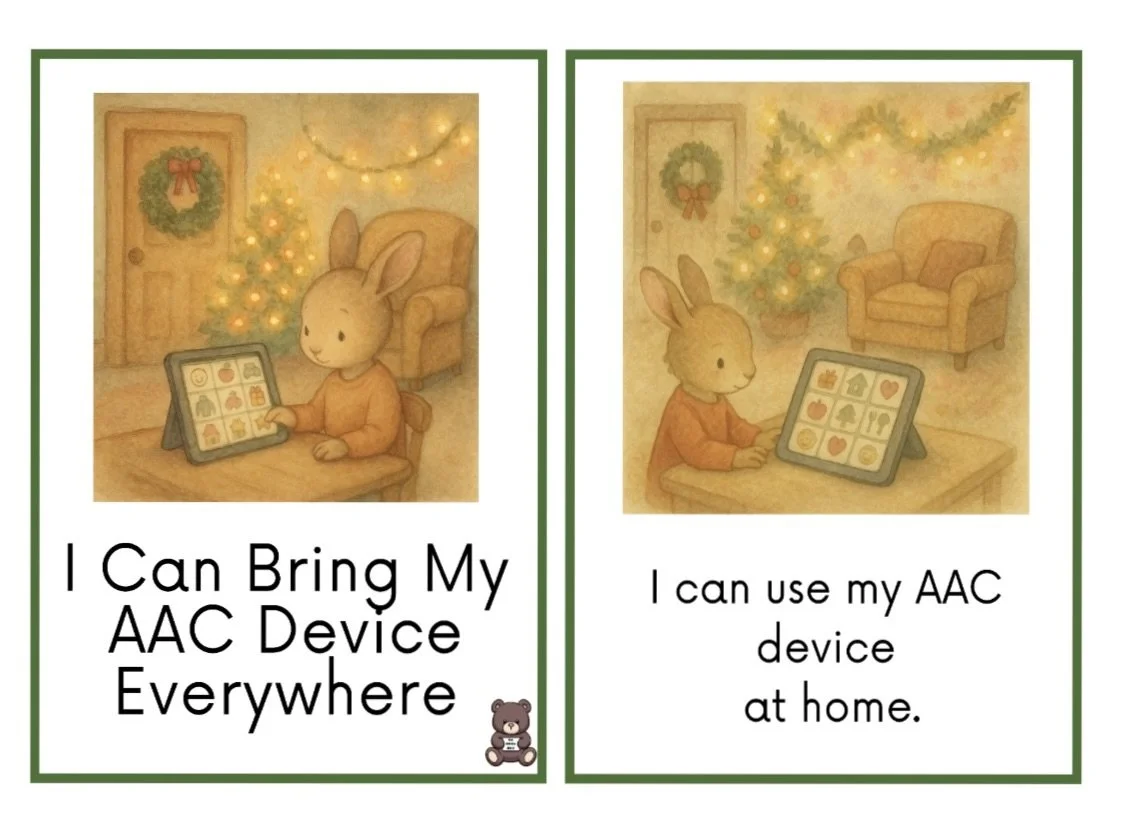
AAC Holiday Social Story – “I Can Bring My AAC Device Everywhere”
This gentle, child-friendly social story supports AAC users in learning that their device can go everywhere with them. Featuring soft, hand-drawn holiday illustrations, this story models device use across familiar routines, like being at home, visiting family, or taking part in seasonal activities.
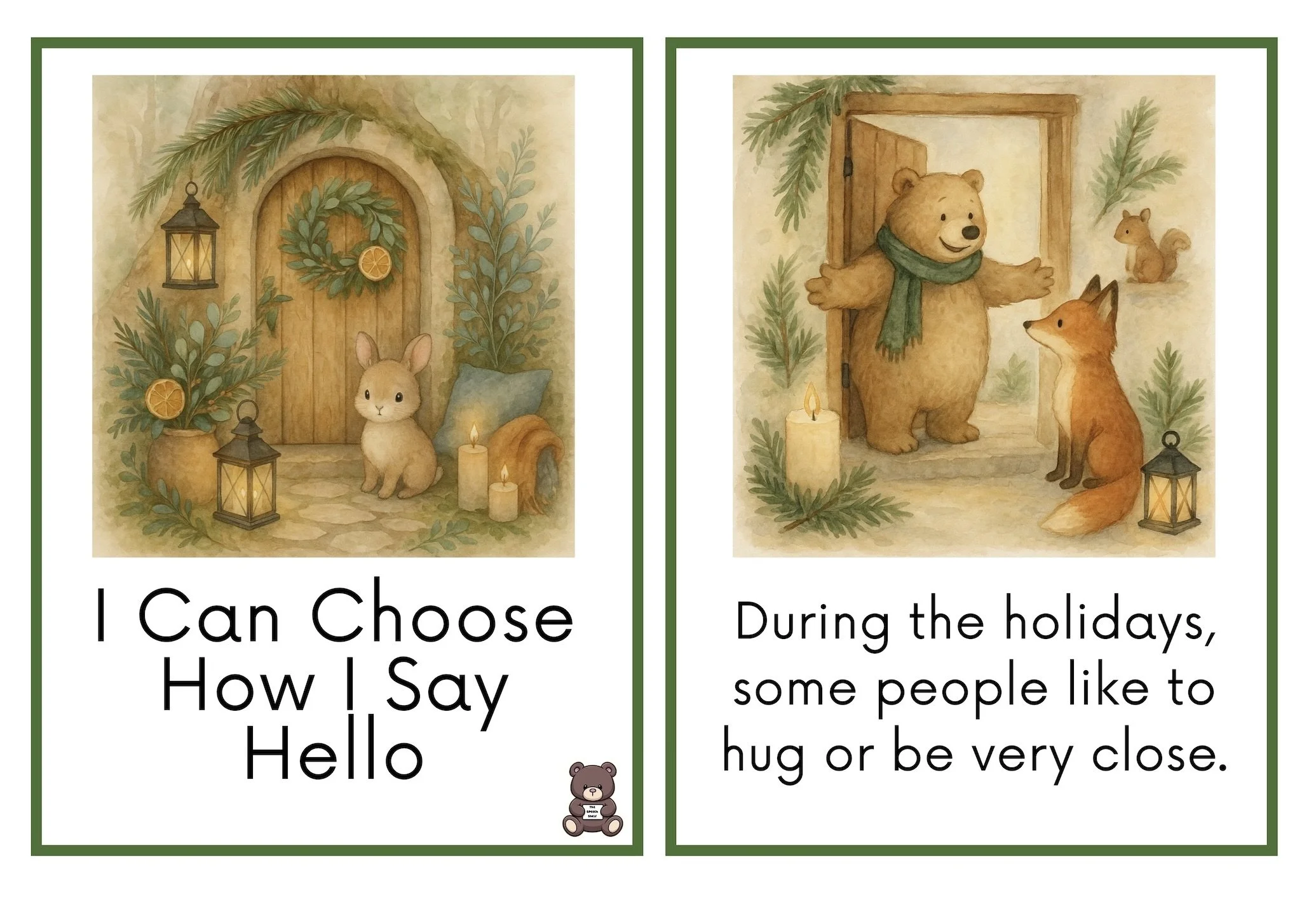
Holiday Social Story – “I Can Choose How I Say Hello”
This gentle, neurodiversity-affirming social story helps children learn that they have full control over how they greet others—especially during busy holiday gatherings. Using warm, hand-drawn woodland illustrations and simple, empowering language, the story teaches boundaries, consent, and self-advocacy
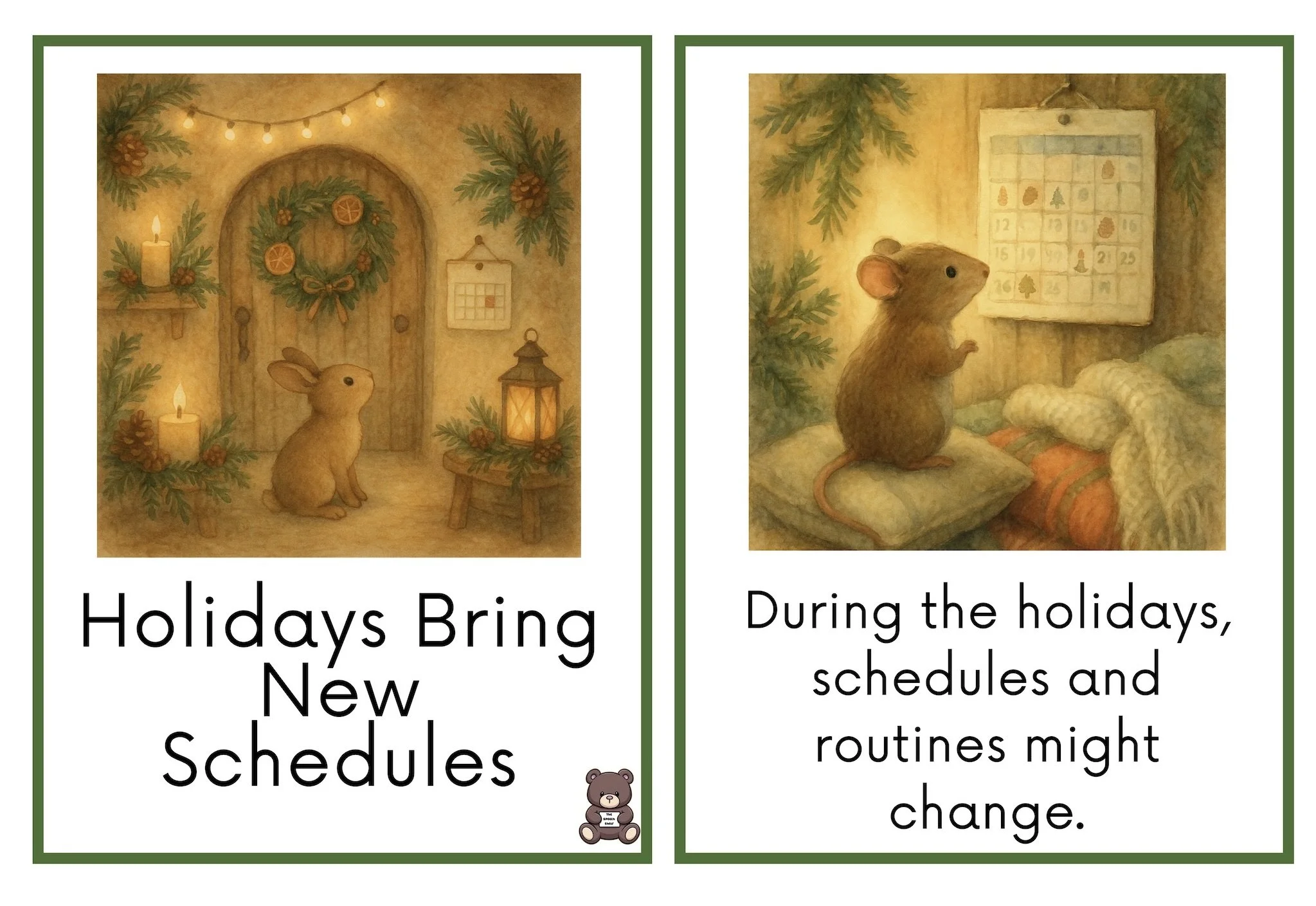
Holiday Social Story – “Holidays Bring New Schedules”
This warm, comforting social story supports children who may feel overwhelmed by the changes that come with holiday routines. Using soft, hand-drawn illustrations and simple, validating language, this resource prepares children for new schedules, unfamiliar events, and emotional ups and downs during the holiday season.
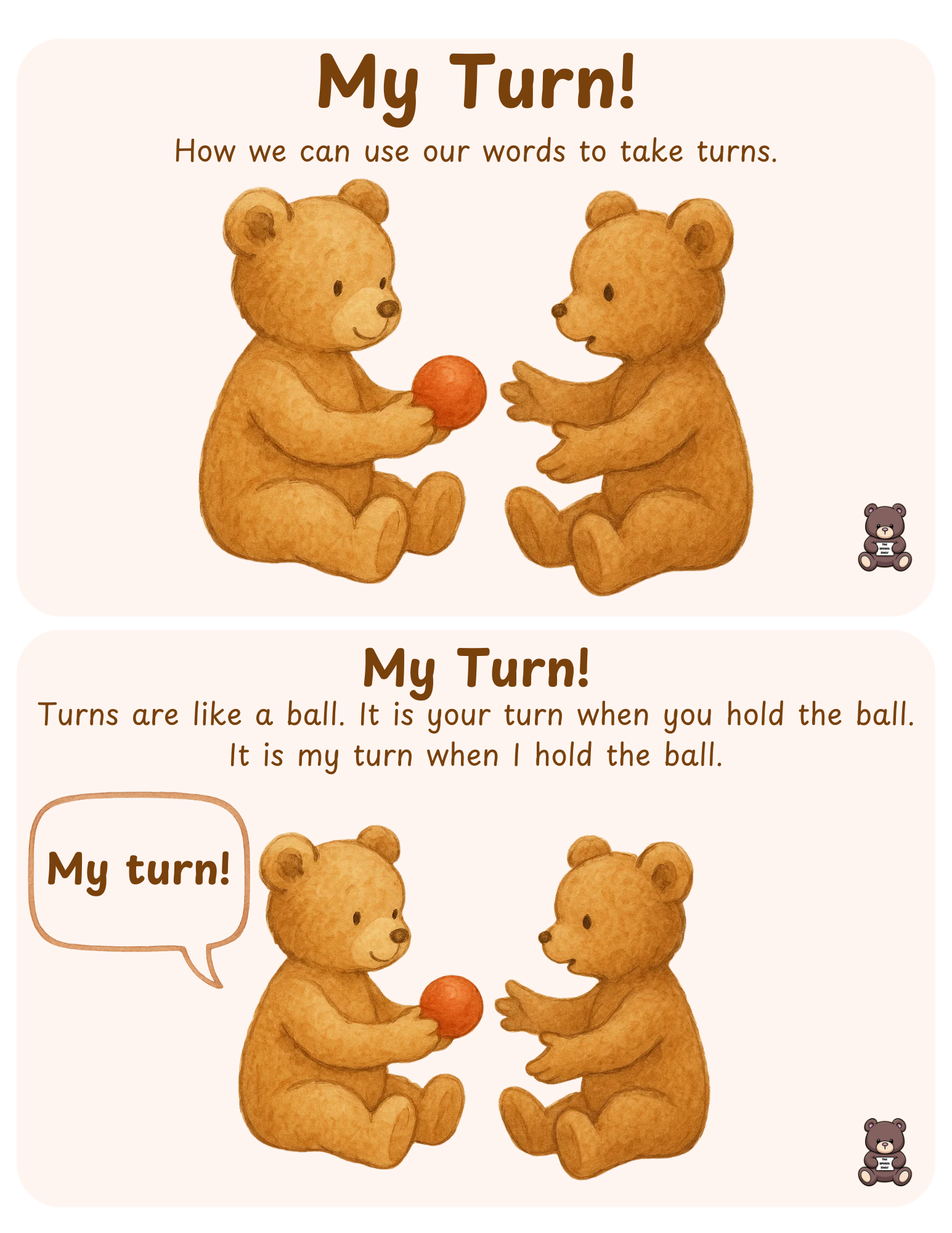
“My Turn” Visual Short Story
This short, visual story helps little communicators see how “my turn” and “your turn” change, just like the ball moves from one friend to another.
This is perfect for supporting early pragmatic language, pronouns, and sharing moments in therapy or at home.

Safari Adventure Powerpoint
Take your students on a Safari Adventure with this interactive PowerPoint! Learners get to explore the savanna and choose from a variety of animals like lions, zebras, elephants, and giraffes. This activity is perfect for targeting vocabulary, answering WH-questions, making choices, and building sentences, all while keeping therapy playful and engaging. Great for both individual and group sessions.
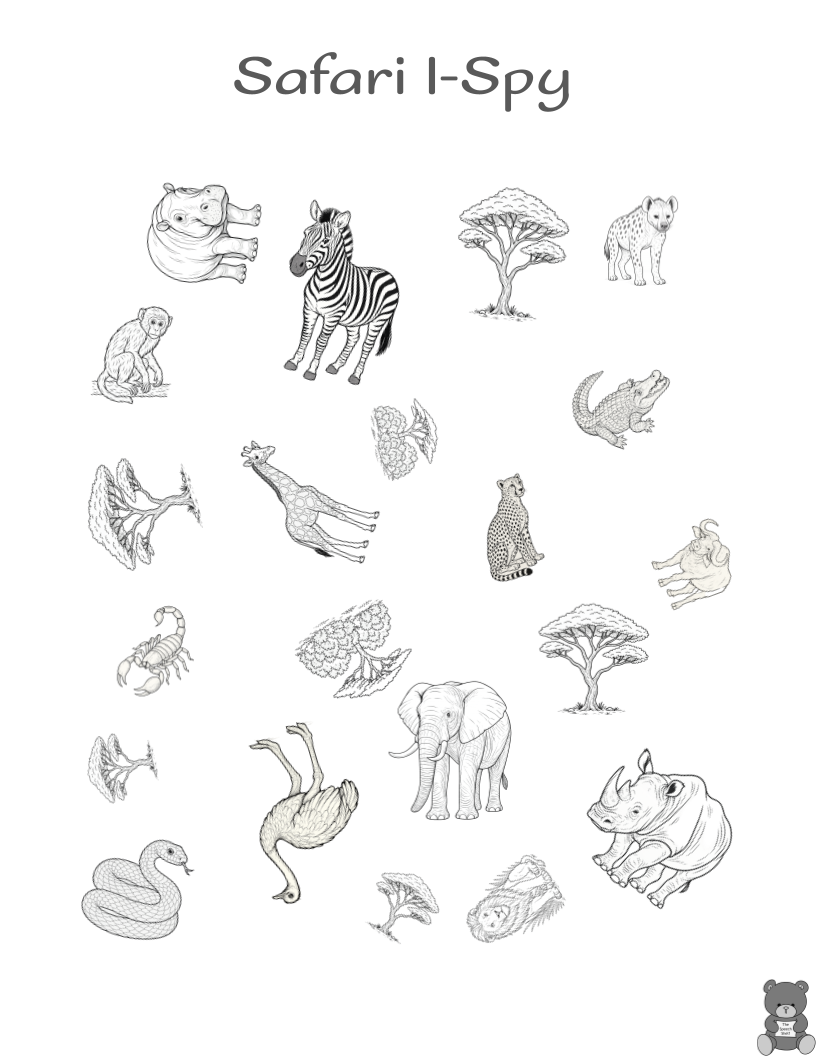
Safari I-Spy Coloring Sheet
This Safari I-Spy activity is a fun and interactive way to target receptive and expressive language skills. Students search for and identify different safari animals hidden across the page, supporting vocabulary development, attention to detail, and comprehension. Perfect to pair with the Safari Adventure PowerPoint for a complete themed lesson that keeps kids engaged and learning through play.
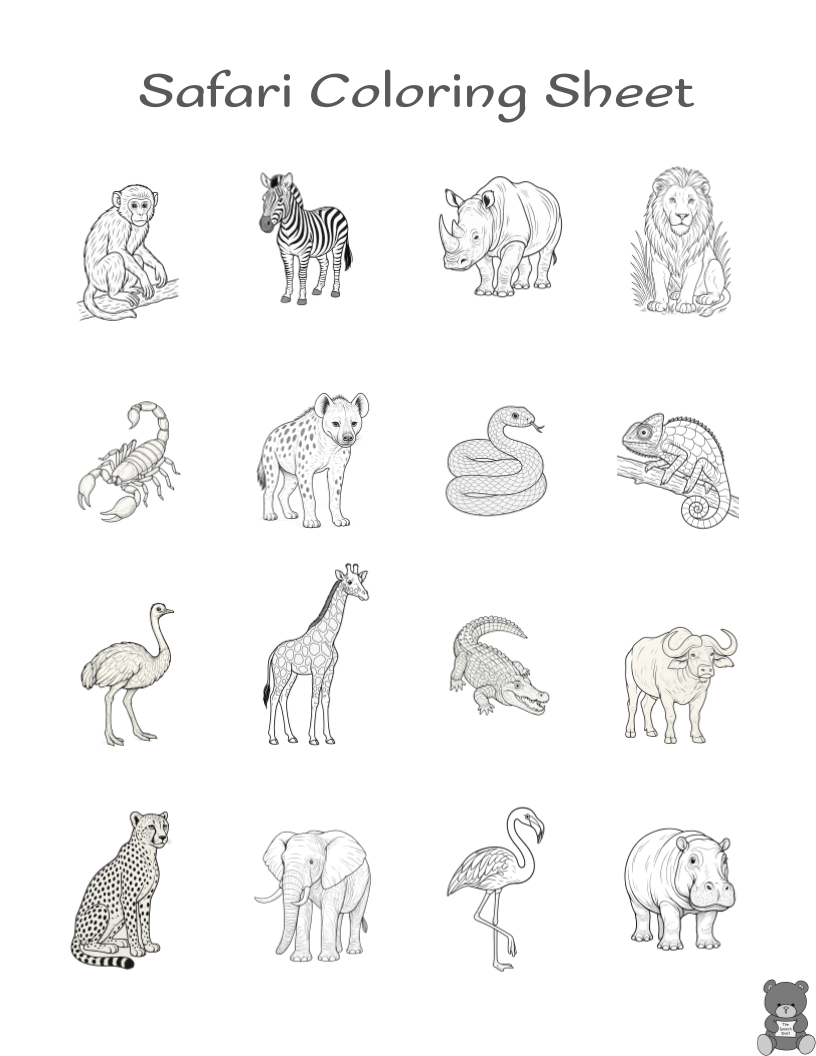
Safari Coloring Sheet
This Safari Coloring Sheet is the perfect extension to the Safari Adventure PowerPoint Activity. After students choose and explore animals during the interactive presentation, they can color their favorite safari animals to reinforce vocabulary, recall, and engagement. A fun and creative way to carry over learning, and add a hands-on element to speech and language sessions.
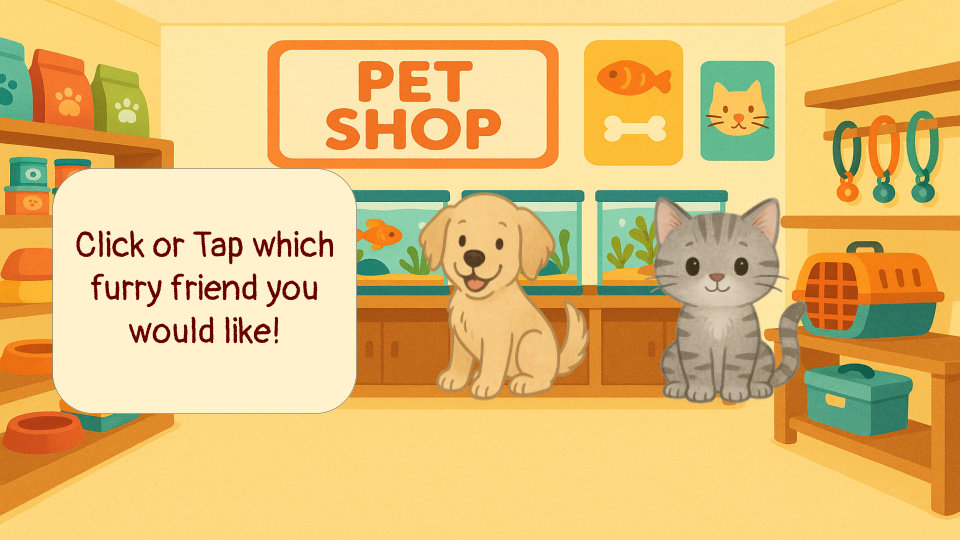
Interactive Pet Shop PowerPoint!
Bring therapy sessions to life with this interactive Pet Shop PowerPoint! Students can click or tap to choose their favorite furry friend, making practice highly engaging and personalized. Perfect for targeting speech and language goals, this activity encourages participation, vocabulary expansion, and expressive communication in a fun, play-based format.
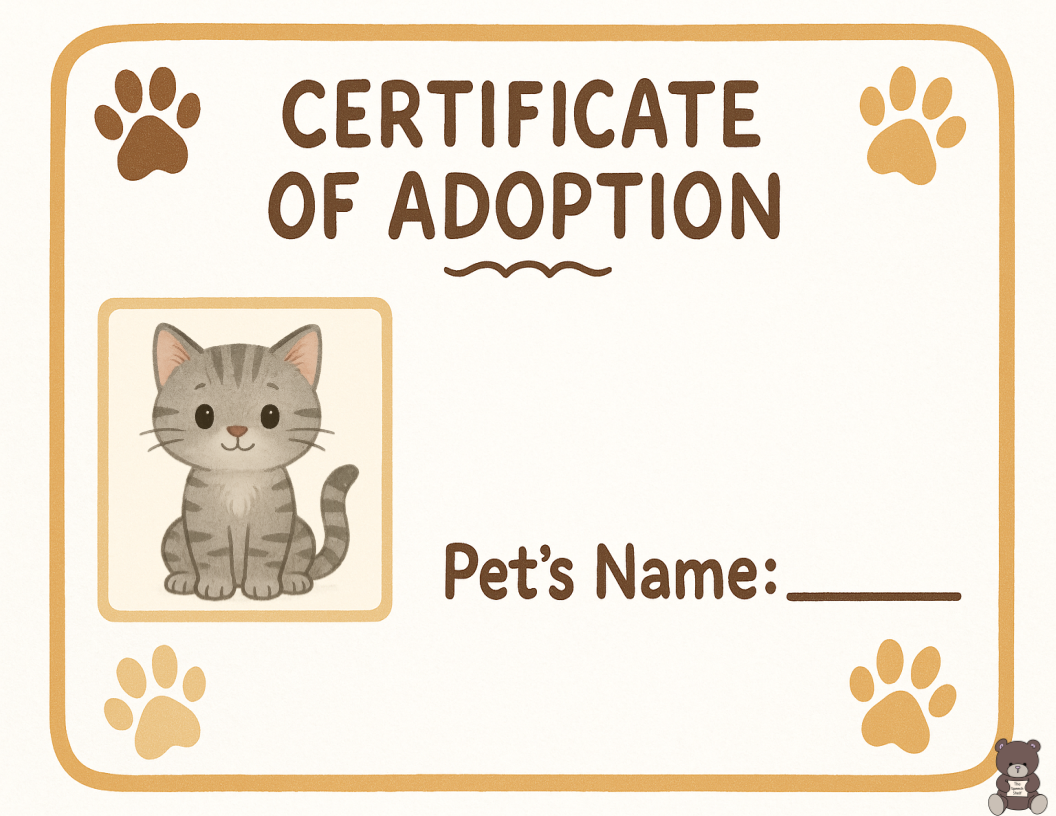
Pet Shop Certificate
This is a Pet Shop Certificate designed to accompany your interactive Pet Shop activity. After students finish the main activity, you can present them with this custom certificate as a fun, motivational reward. It helps reinforce achievement and gives learners something tangible to celebrate!
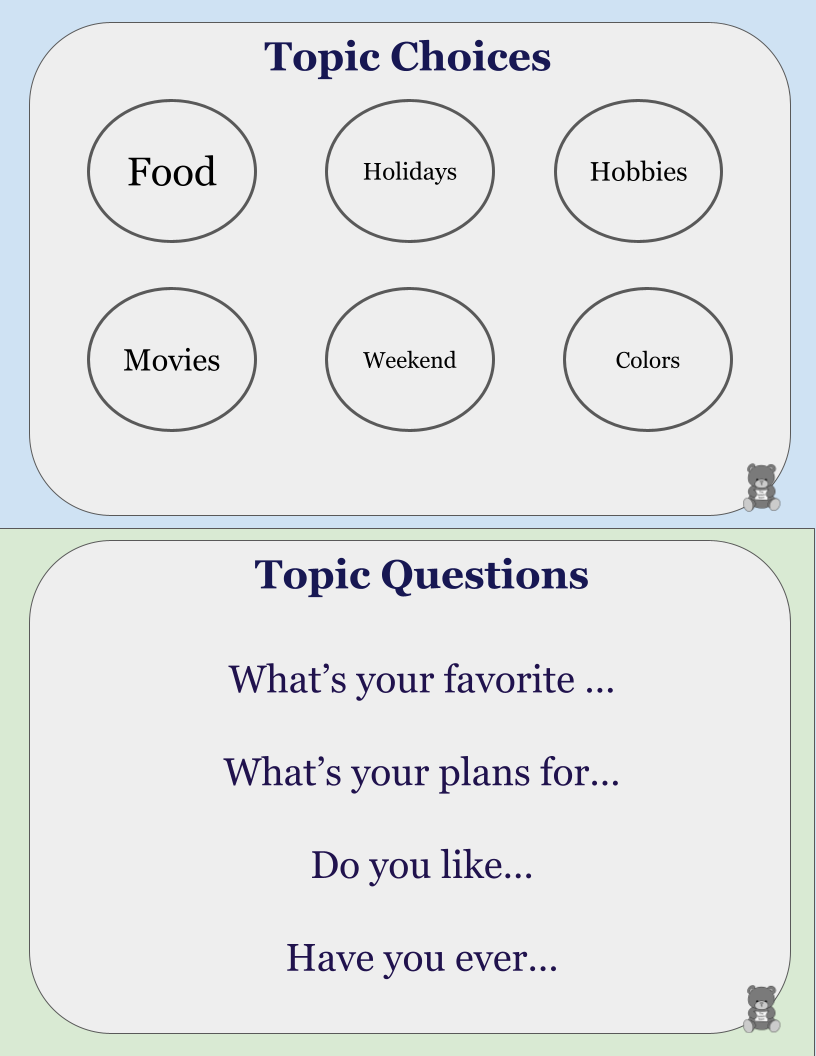
Conversational Cue Cards
These Conversational Cue Cards are perfect for building social communication and conversation skills. Students can choose a topic like Food, Holidays, or Hobbies, then use the included starter questions (“What’s your favorite…?”, “Do you like…?”, etc.) to practice turn-taking, topic maintenance, and expressive language. A fun, interactive tool for therapy sessions, groups, or social skills practice.
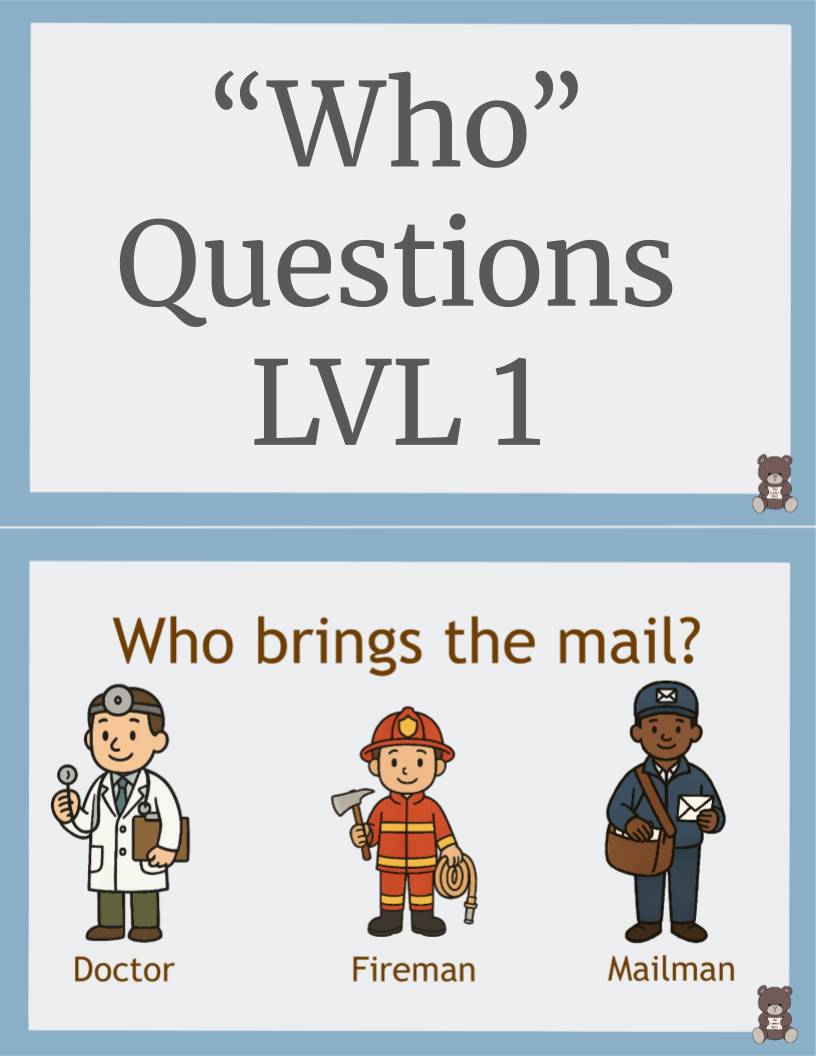
Who” Questions Level 1
This “Who” Questions Level 1 activity is designed to help students practice answering basic who questions with simple visuals and multiple-choice options. Perfect for early learners or those working on comprehension, vocabulary, and WH-question skills, this activity supports engagement through clear pictures and functional question prompts.
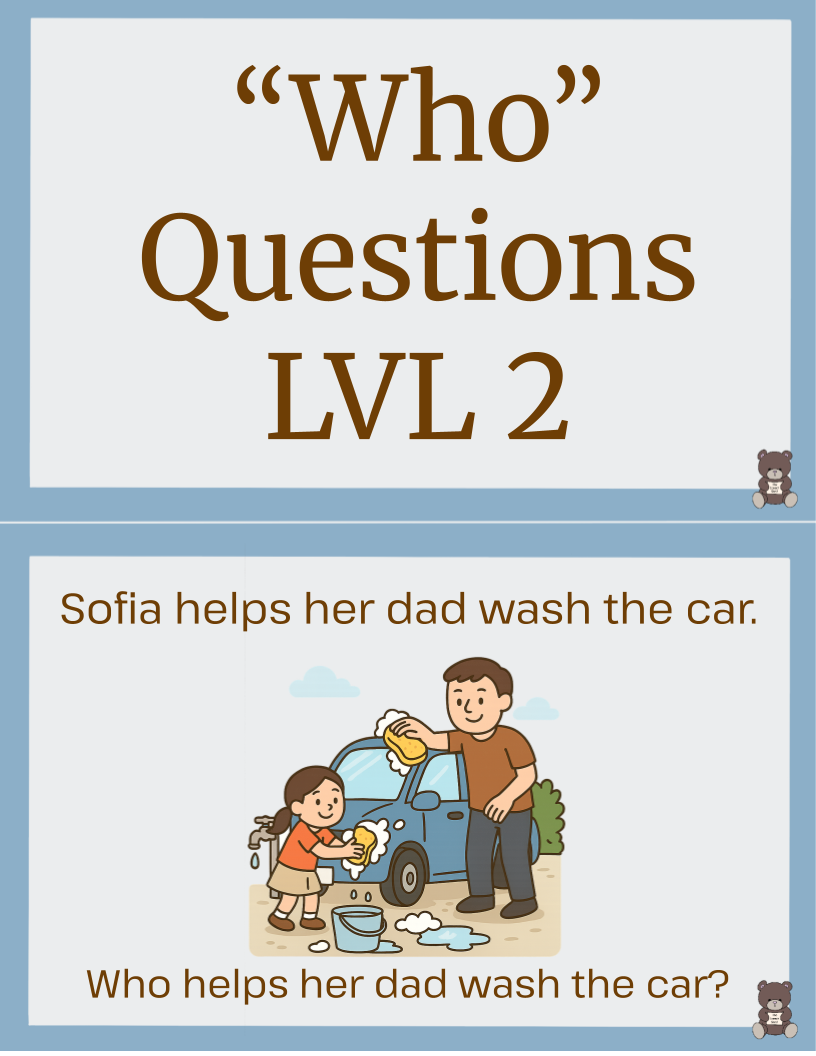
Who” Questions Level 2
This “Who” Questions Level 2 activity helps students practice answering who questions with short sentences and visual support. By moving beyond simple choices, learners develop comprehension, grammar, and expressive language skills in context. Perfect for targeting WH-questions, building vocabulary, and strengthening sentence structure in therapy sessions.
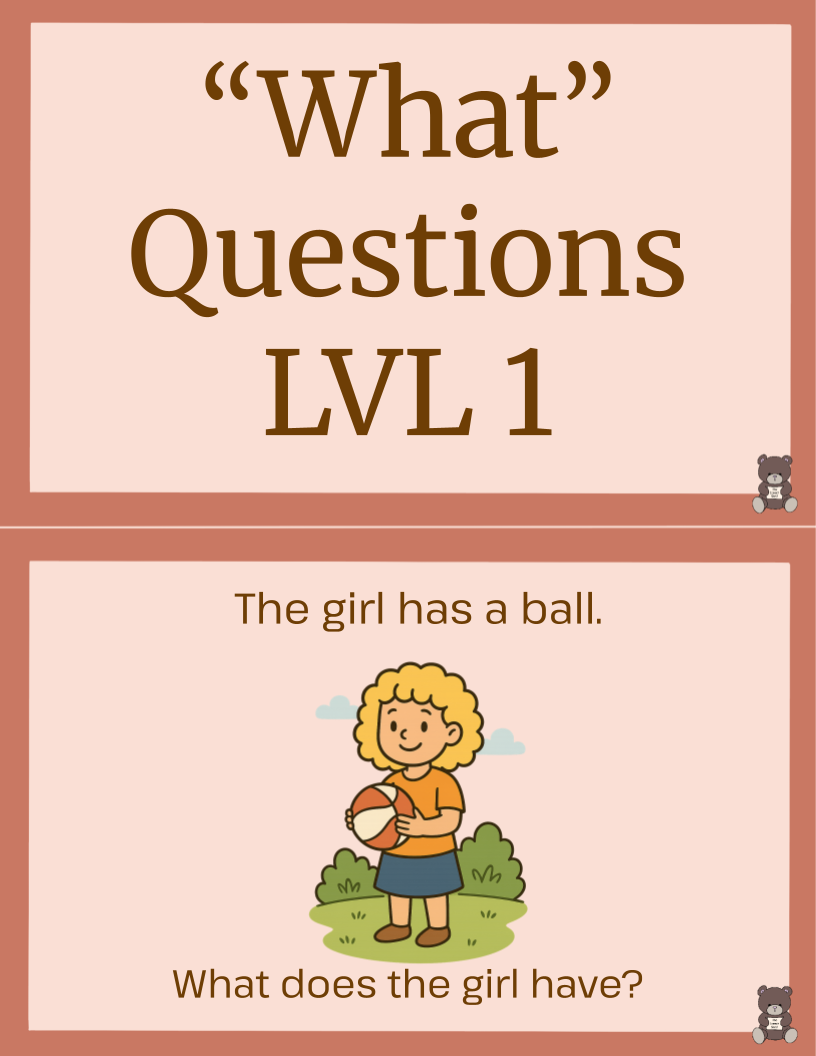
What” Questions Level 1
This “What” Questions Level 1 activity is designed to help students build foundational WH-question skills. Using simple sentences and clear visuals, learners practice answering basic questions in a supportive format. Perfect for early learners, speech therapy sessions, or language enrichment, this resource strengthens comprehension, vocabulary, and expressive language skills.
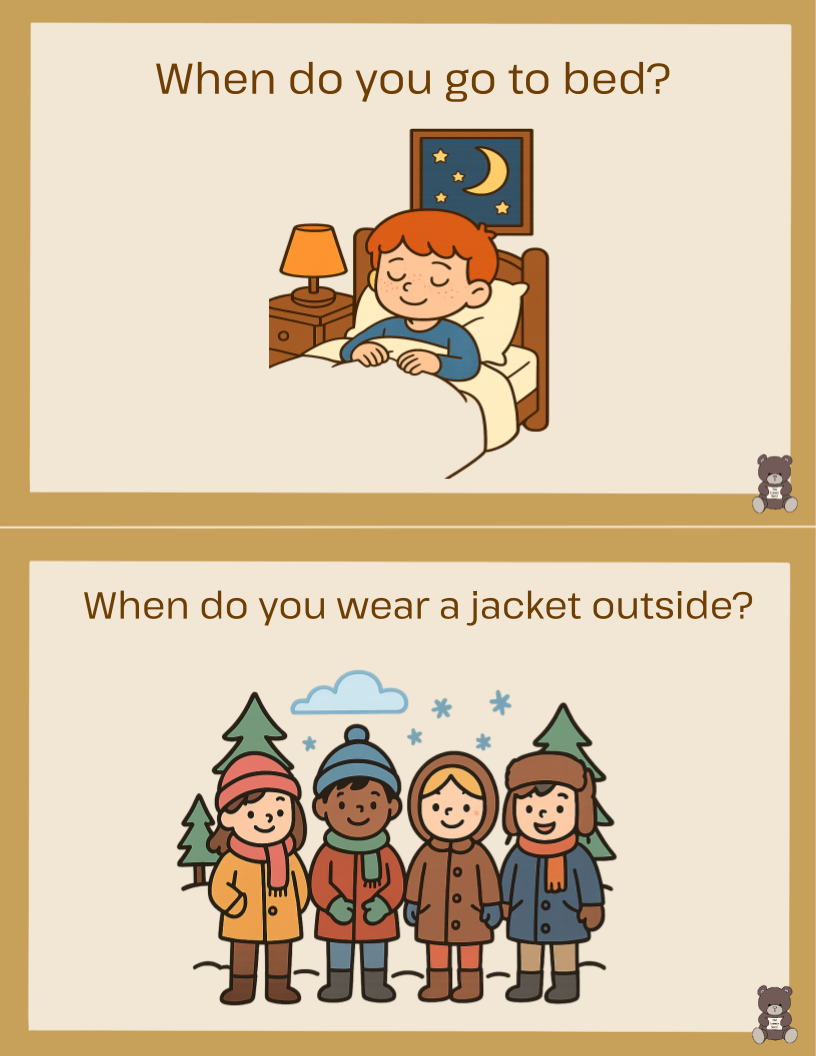
When Questions
This “When” Questions activity helps students strengthen their ability to answer temporal WH-questions using clear visuals and relatable scenarios. By practicing questions like “When do you wake up?”, learners develop comprehension, sequencing, and expressive language skills. Perfect for targeting WH-questions, building functional communication, and supporting carryover in therapy sessions.
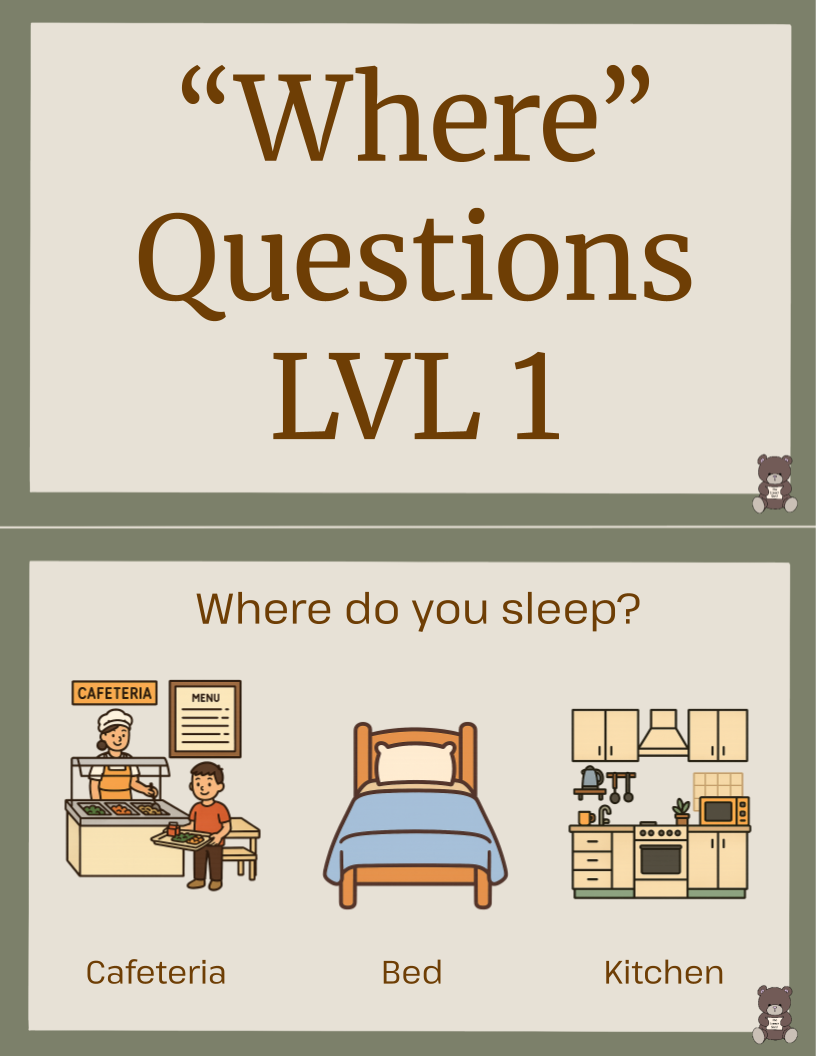
“Where” Questions Level 1
This “Where” Questions Level 1 activity introduces students to answering simple location-based WH-questions. With clear visuals and multiple-choice answers, prompts like “Where do you sleep?” help learners practice comprehension, vocabulary, and expressive language in an engaging way. Perfect for early learners, speech therapy, and language intervention sessions.
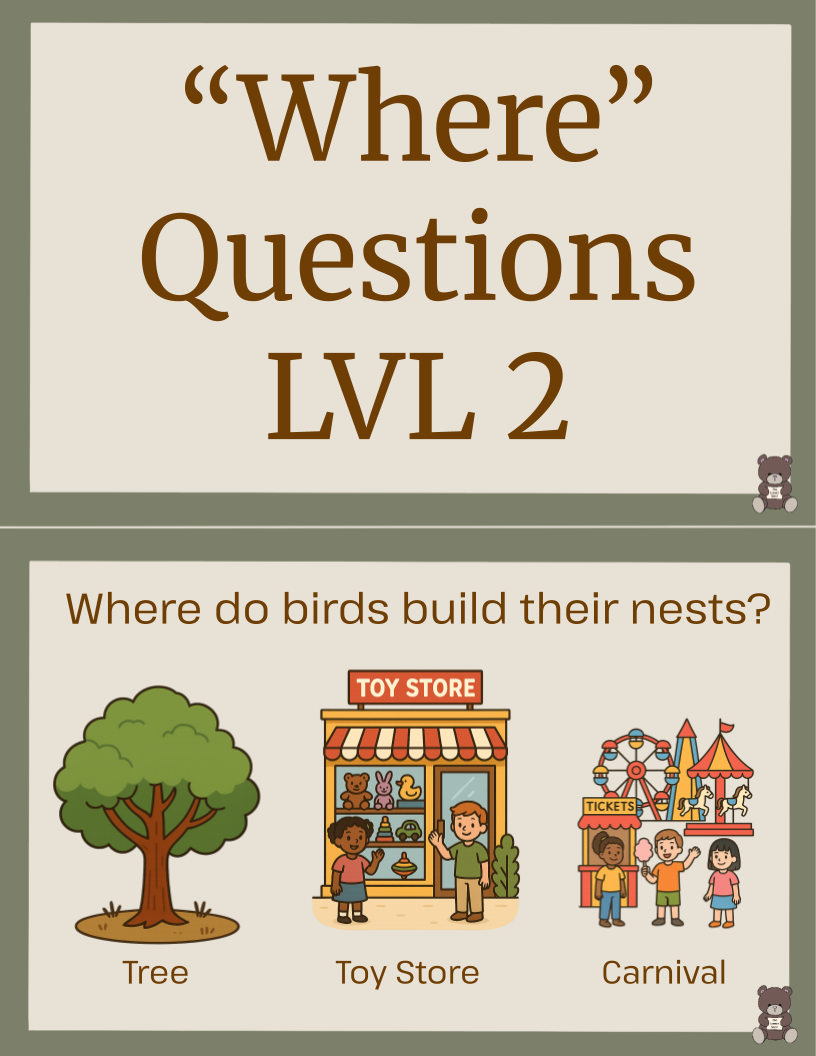
“Where” Questions Level 2
This “Where” Questions Level 2 activity helps students practice answering location-based WH-questions with engaging visuals and multiple-choice options. Prompts like “Where do birds build their nests?” support comprehension, vocabulary, and reasoning skills. Ideal for speech therapy sessions focused on WH-questions, language enrichment, and building expressive communication.
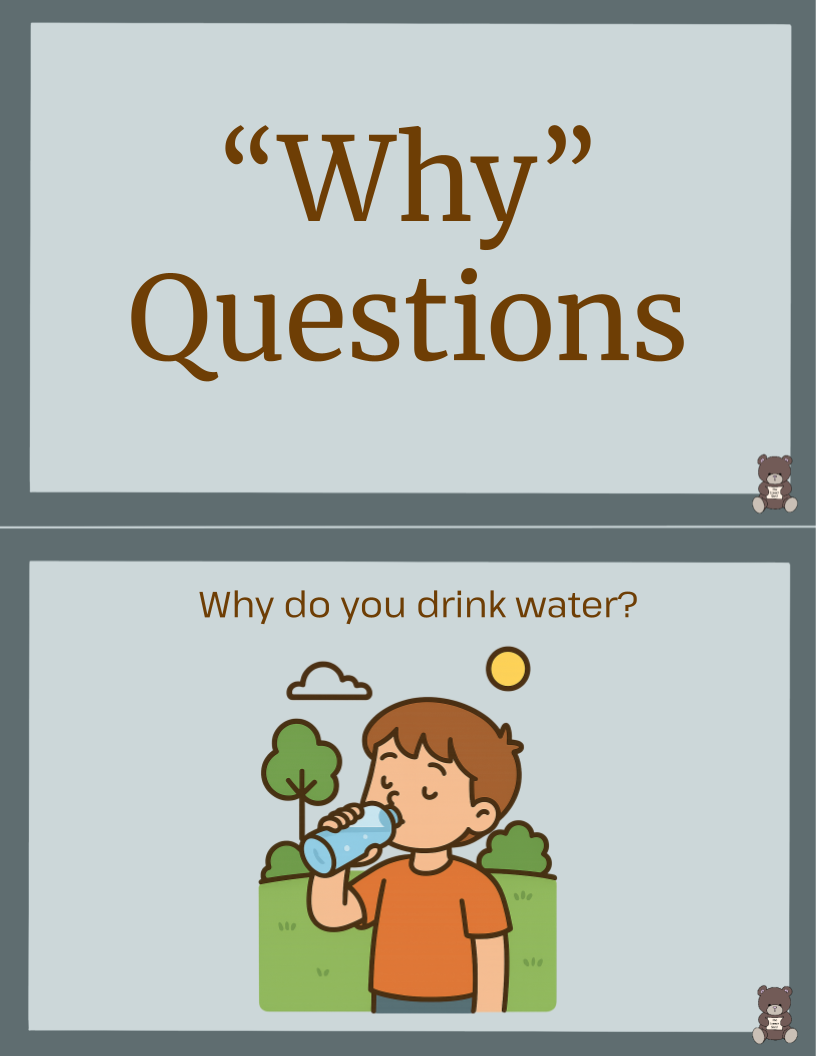
Why Questions
This “Why” Questions activity supports students in practicing reasoning and cause-and-effect thinking. With simple visuals and clear prompts like “Why do you drink water?”, learners build comprehension, expressive language, and problem-solving skills. Perfect for targeting WH-questions and encouraging deeper responses in therapy sessions.
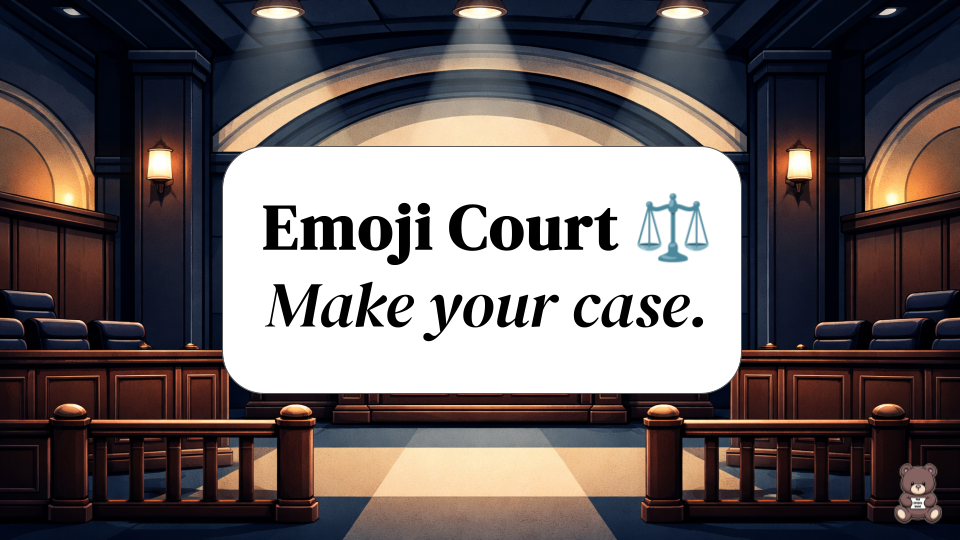
Emoji Inferencing Slides
Emoji Court is an engaging, discussion-based inferencing activity designed to strengthen higher-level language skills through visual reasoning and evidence-based thinking. Students are presented with sets of emojis and asked to make an inference about what happened, defend their reasoning with evidence, and consider alternative explanations, just like making a case in court. There is no single correct answer, encouraging flexible thinking and expressive language.
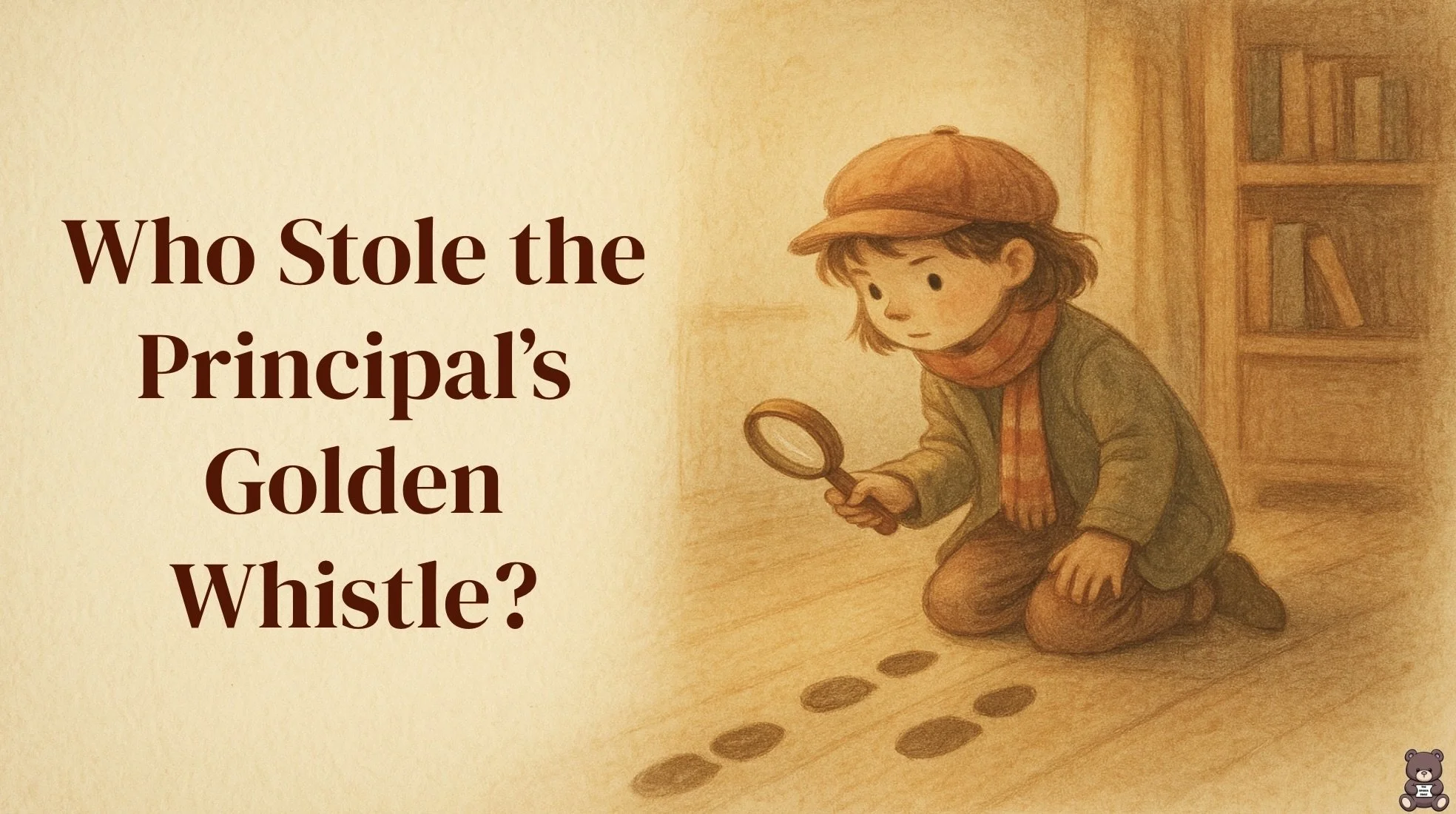
“WH” Mystery Powerpoint
Bring excitement into your speech room with this mystery lesson!
Students become detectives as they gather clues, question suspects, and use WH-questions (who, what, where, when, why) to solve the case of the missing golden whistle.
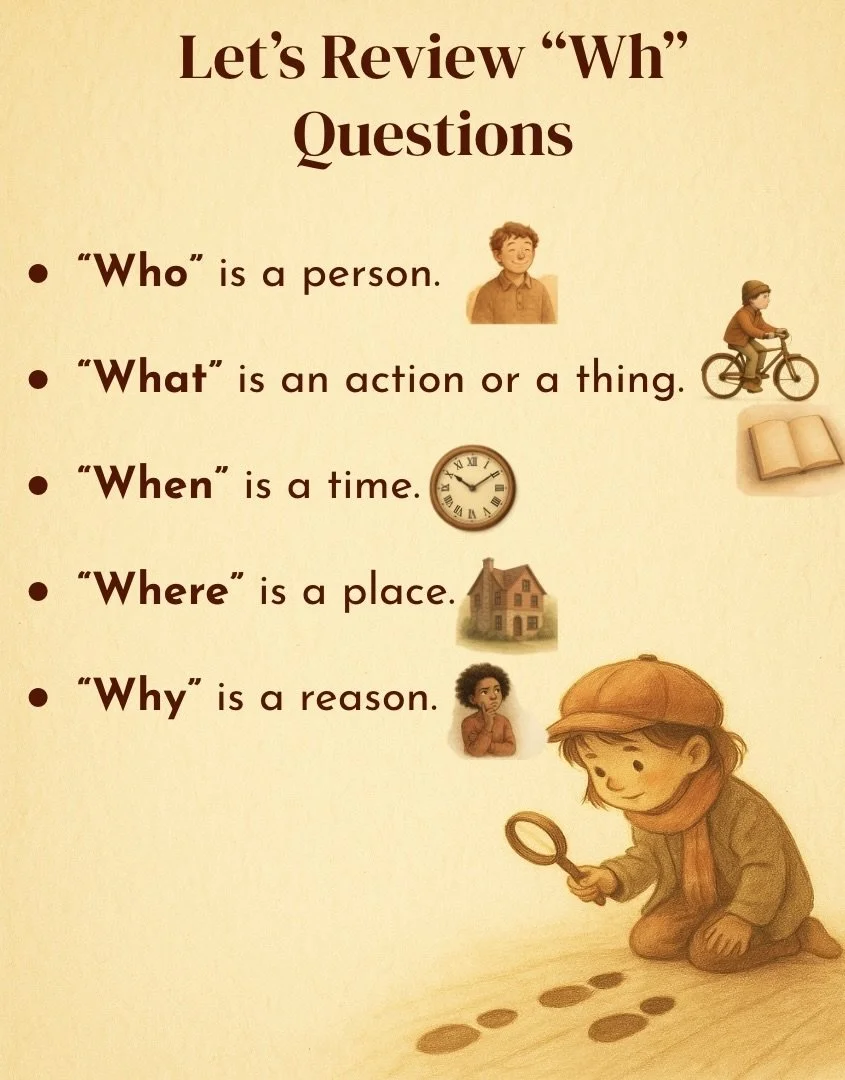
WH Mystery Guide
A student-friendly guide to “Who, What, Where, When, and Why” questions.
Use it as a visual reminder before starting WH-activities, or print and laminate for small-group use. Great to use with the mystery powerpoint!
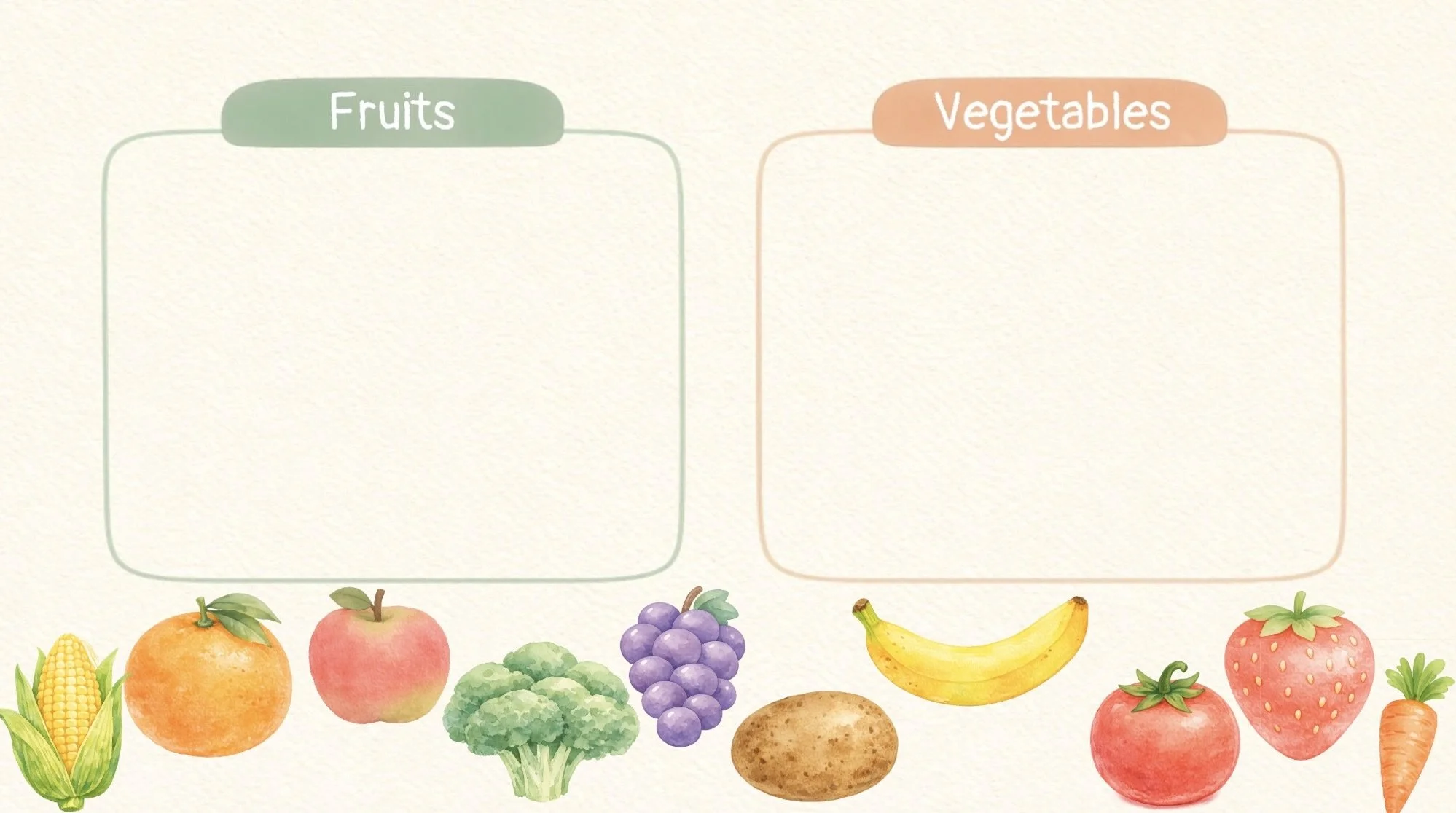
Sorting Categories- Drag & Drop Slides
This google slides activity targets core concepts through category sorting. Clients sort pictures into the box where they belong based on concepts such as big vs. small, hot vs. cold, fruits vs. vegetables, clean vs. dirty, and letters vs. numbers.
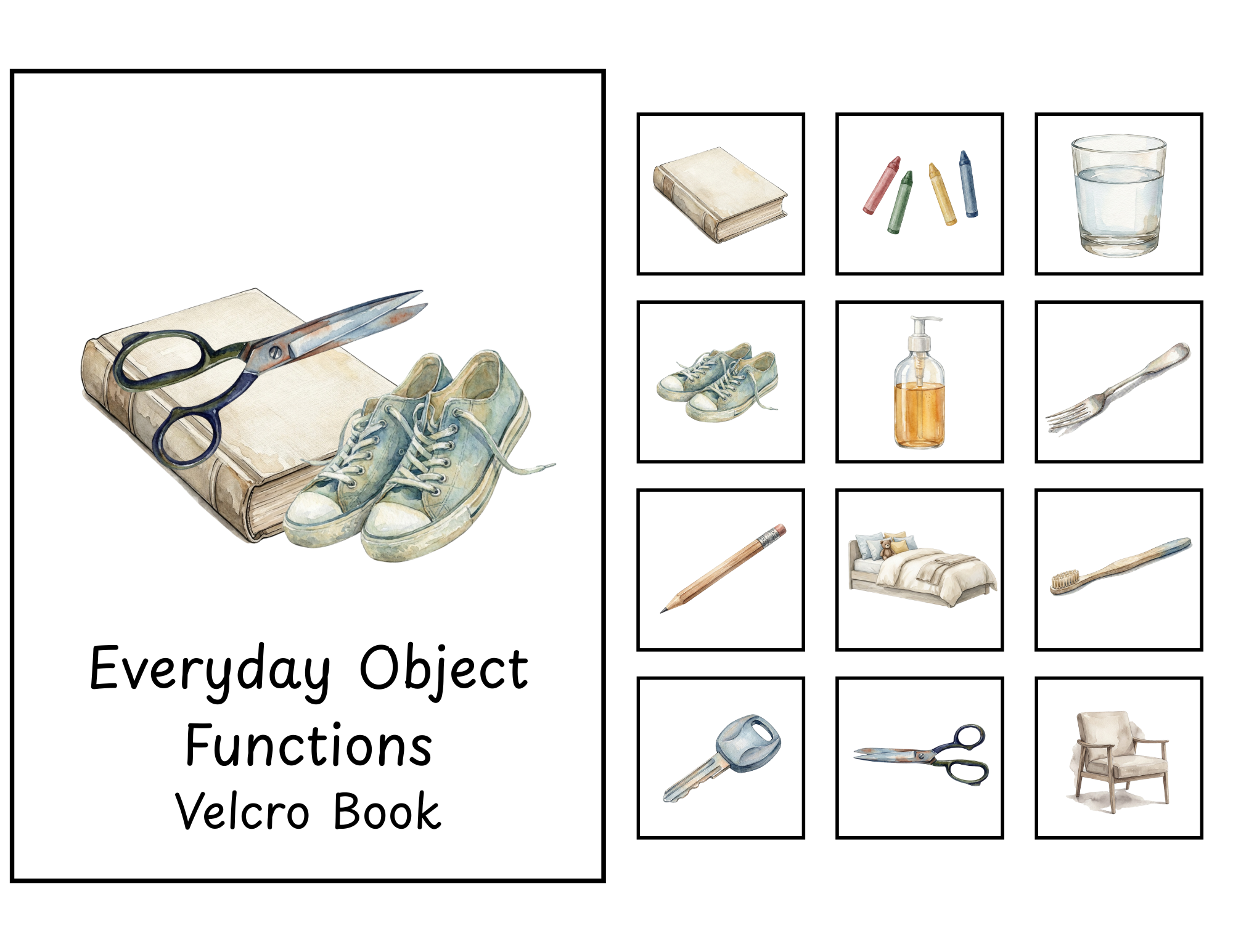
Everyday Object Function Velcro Book
This Object Functions Velcro Book is a beautiful and developmentally intentional language resource designed for early learners, AAC users, and children working on vocabulary that builds independence. This booklet supports meaningful engagement with 12 everyday objects by separating the function (what we do with something) from the object (the item itself).
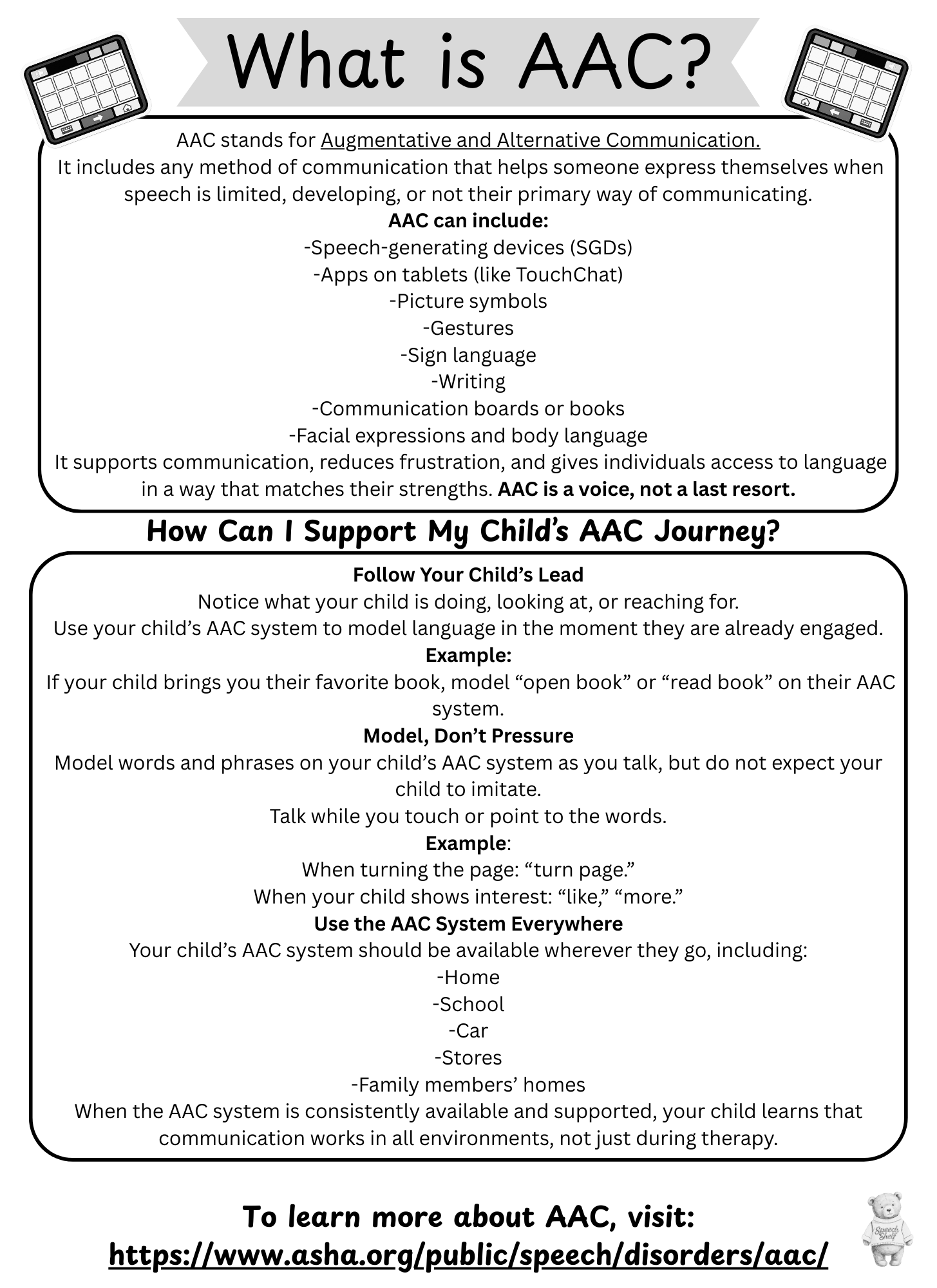
AAC Handout for Parents
This handout explains what AAC (Augmentative and Alternative Communication) is and why it’s an important support for individuals with limited or developing speech. It also provides simple, family-friendly strategies to model and encourage AAC use across everyday routines.
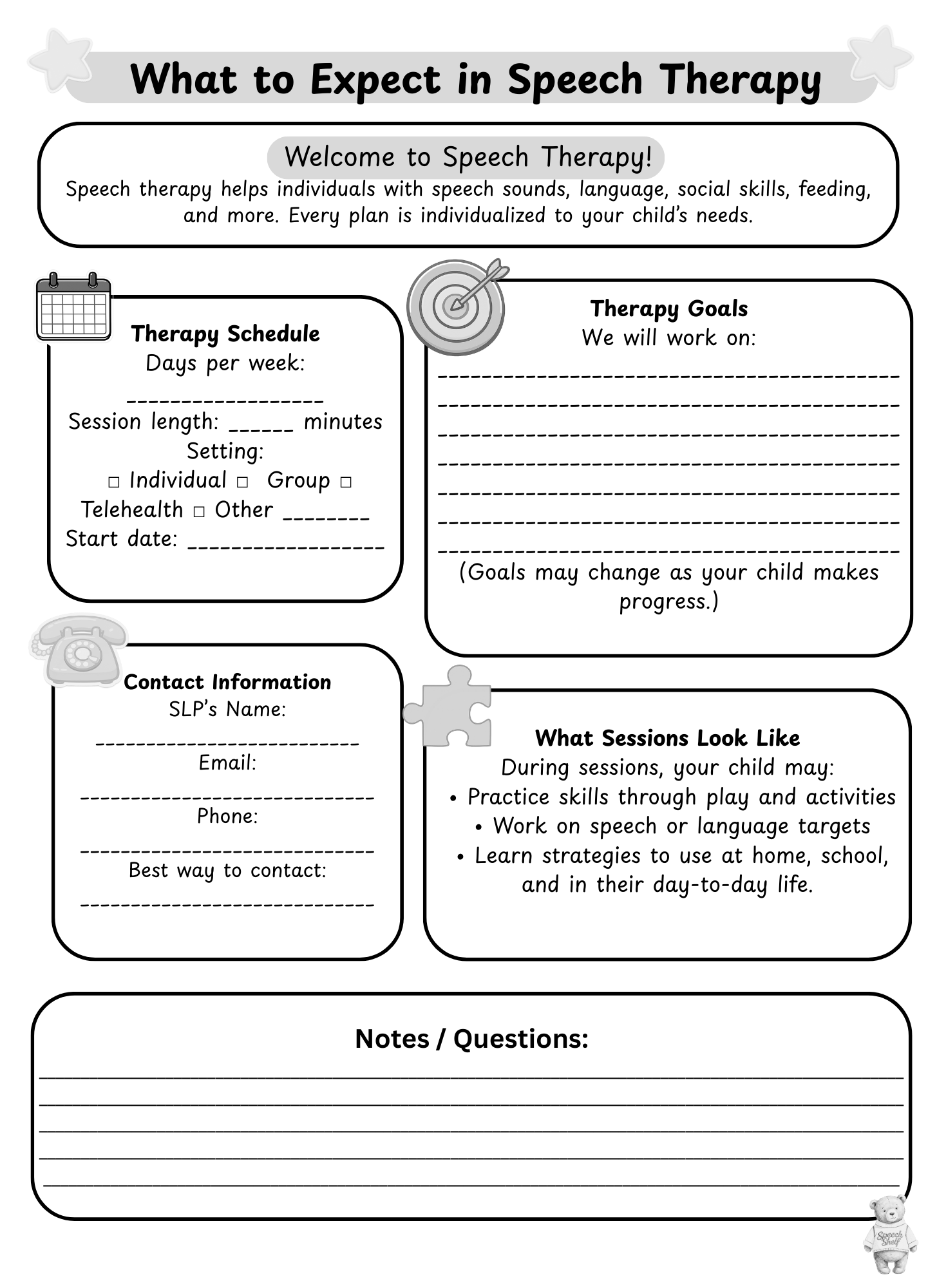
“What to Expect in Speech Therapy” Parent Handout
A simple, parent-friendly handout that explains what to expect in speech therapy, including goals, session structure, and contact information. Perfect for sending home at the start of services or during evaluations.
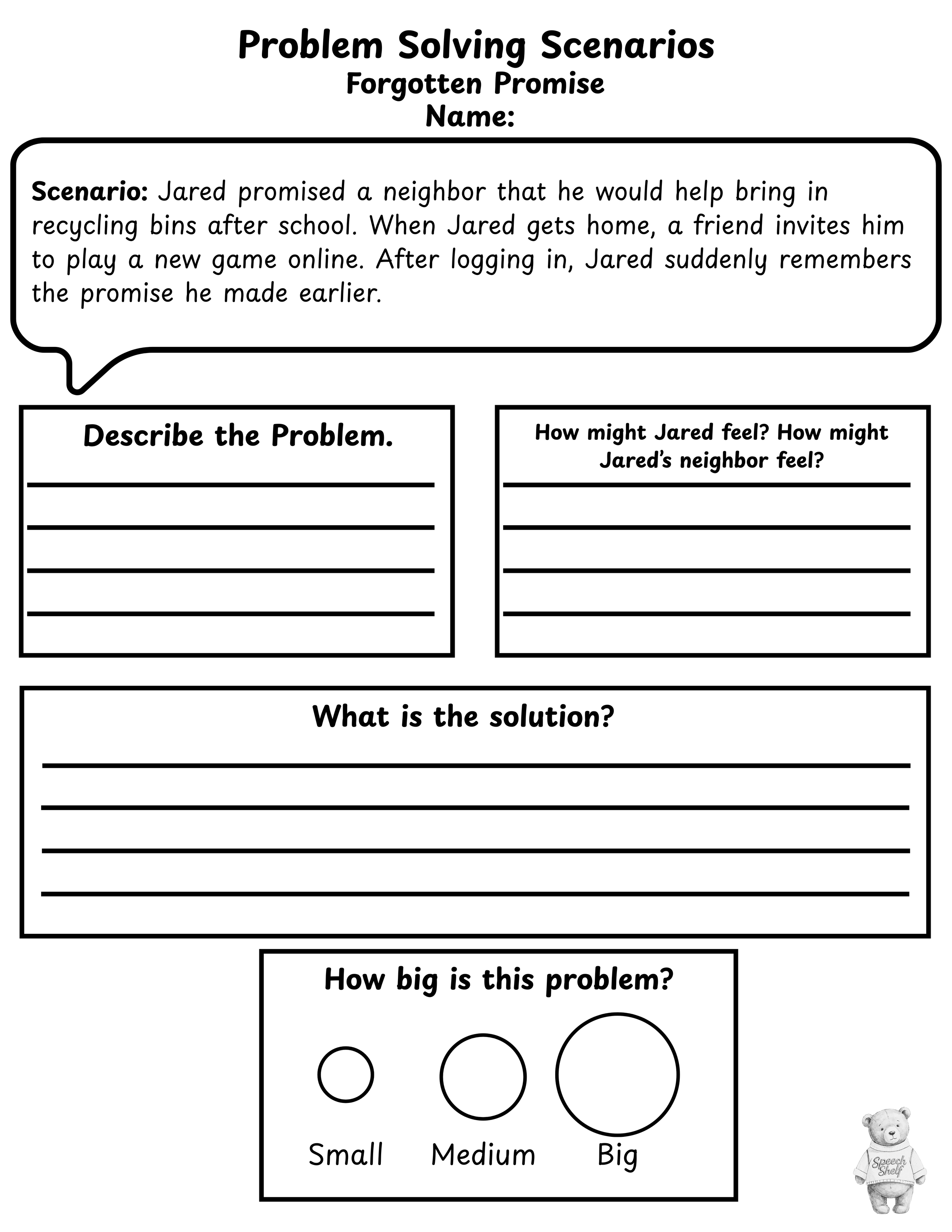
Problem Solving Scenarios
Problem Solving Scenarios helps older students strengthen critical thinking, inferencing, and problem-solving skills through realistic, age-appropriate situations. Students analyze each scenario by identifying the problem, inferring possible emotions, determining the size of the problem, and brainstorming thoughtful solutions.
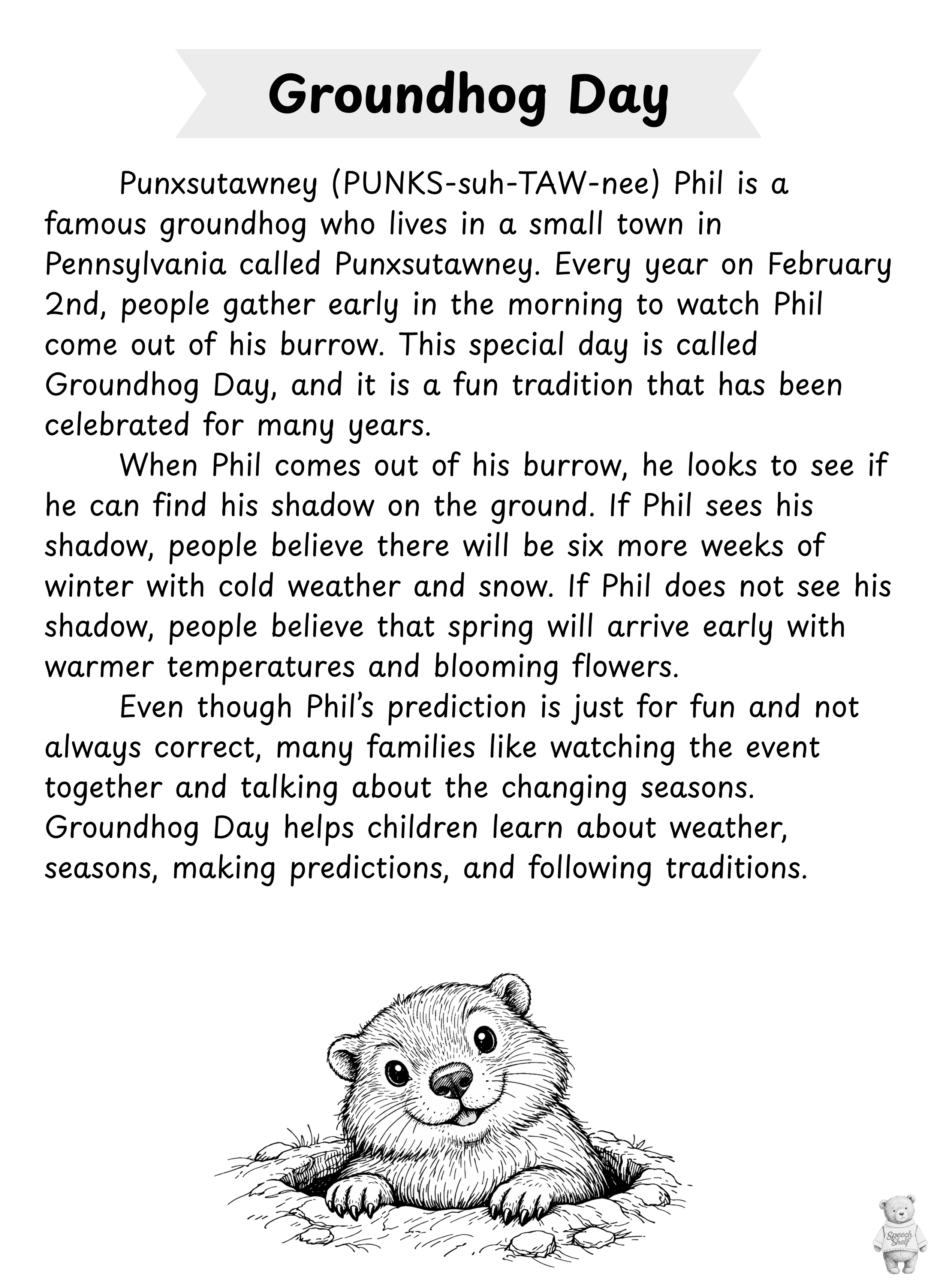
Groundhog Day Passage and Activities
This Groundhog Day resource helps students learn about Punxsutawney Phil through a short reading passage and comprehension questions. Students practice sequencing events, answering questions, and making predictions about whether winter will last longer or spring will arrive early.
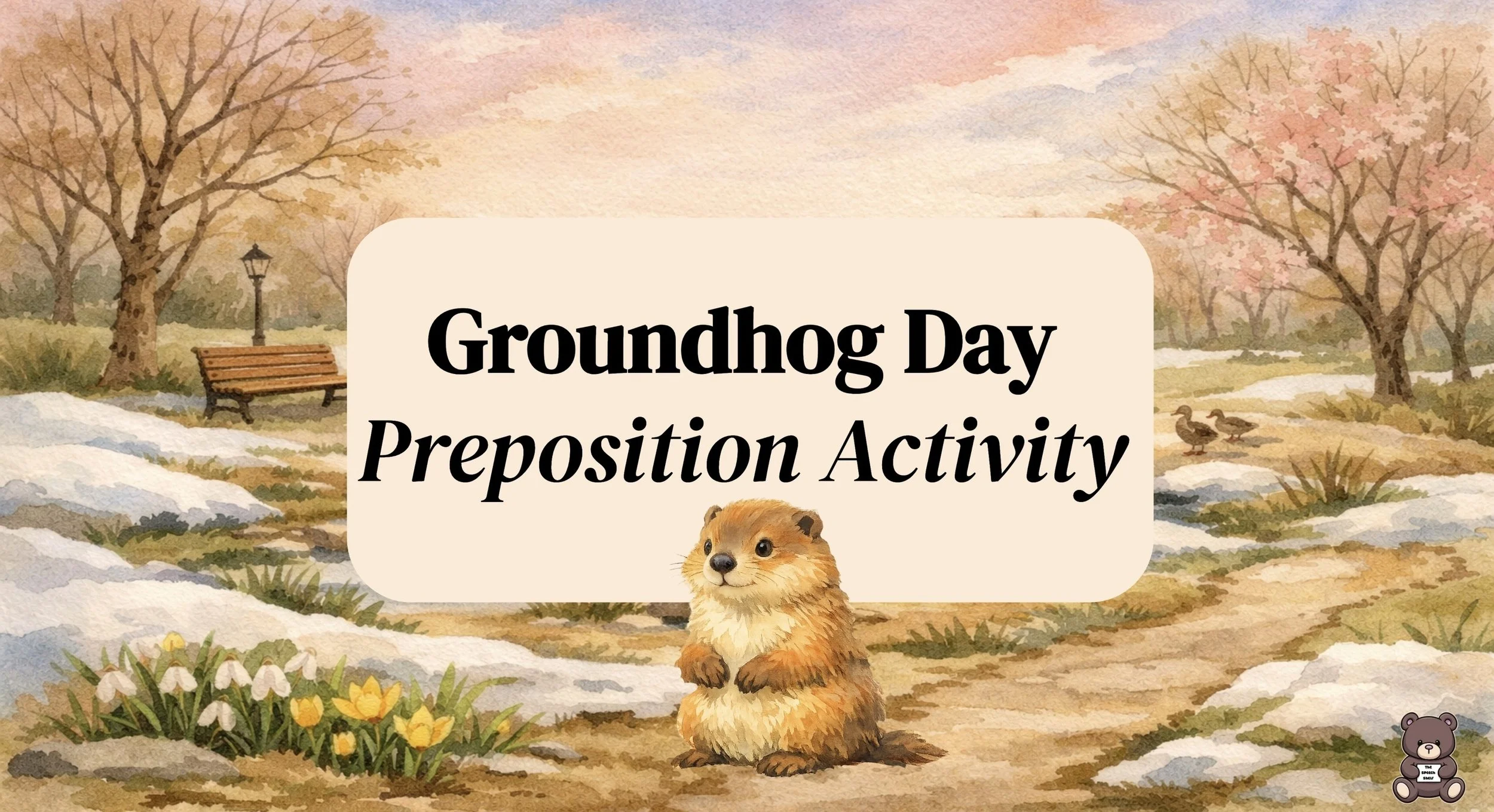
Groundhog Day Preposition Activity- Drag & Drop Slides
This interactive Groundhog Day activity helps students practice spatial prepositions by following visual directions and placing the groundhog in different locations within each scene. It supports receptive language, following directions, and an understanding of prepositions while keeping students engaged with seasonal watercolor visuals.
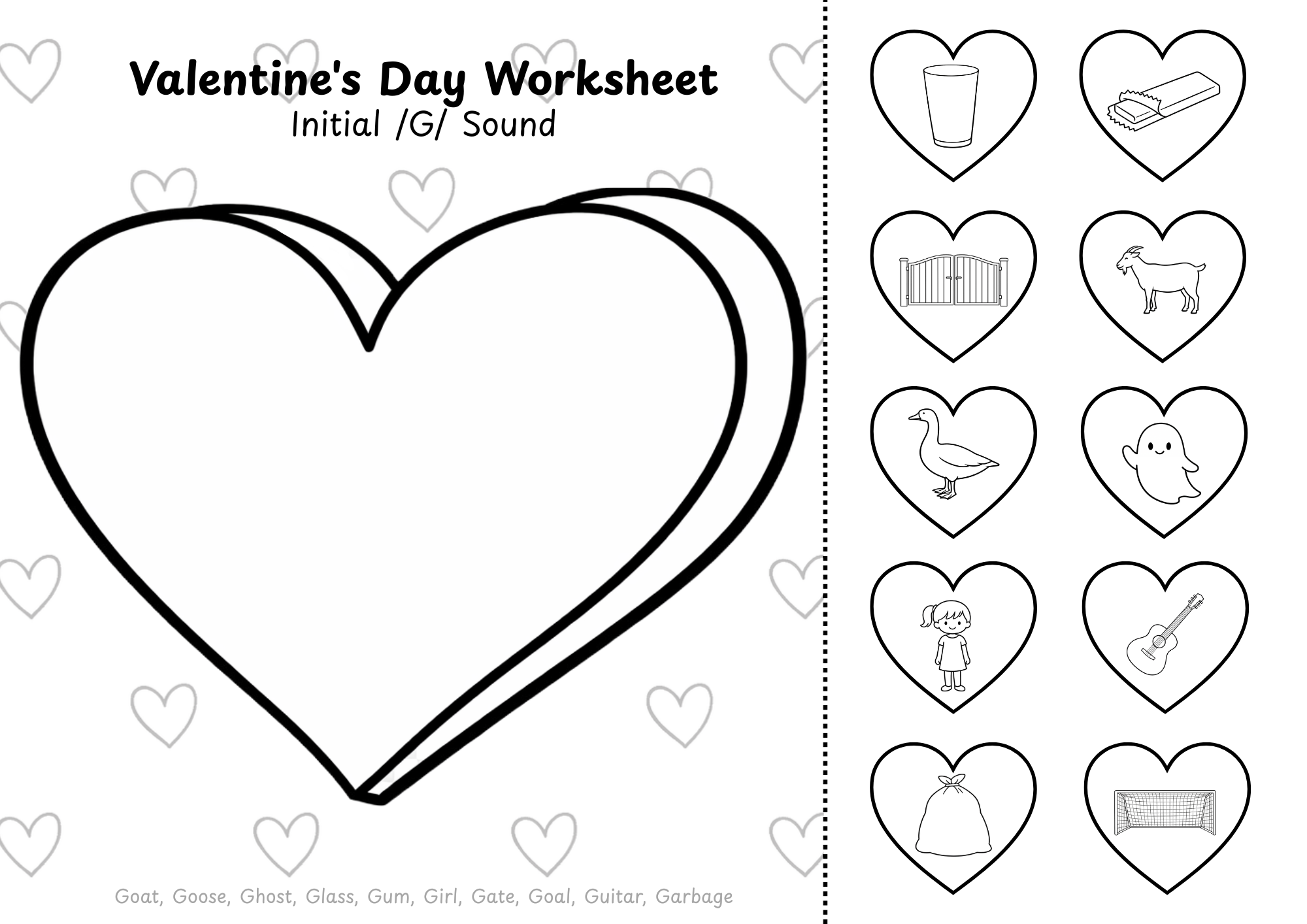
Valentine’s Day Articulation Worksheets
This Valentine’s Day articulation worksheet targets initial sounds (/S/, voiceless /TH/, /K/, /G/, and /R/) using engaging cut-and-paste heart visuals. Designed for print-and-go therapy.
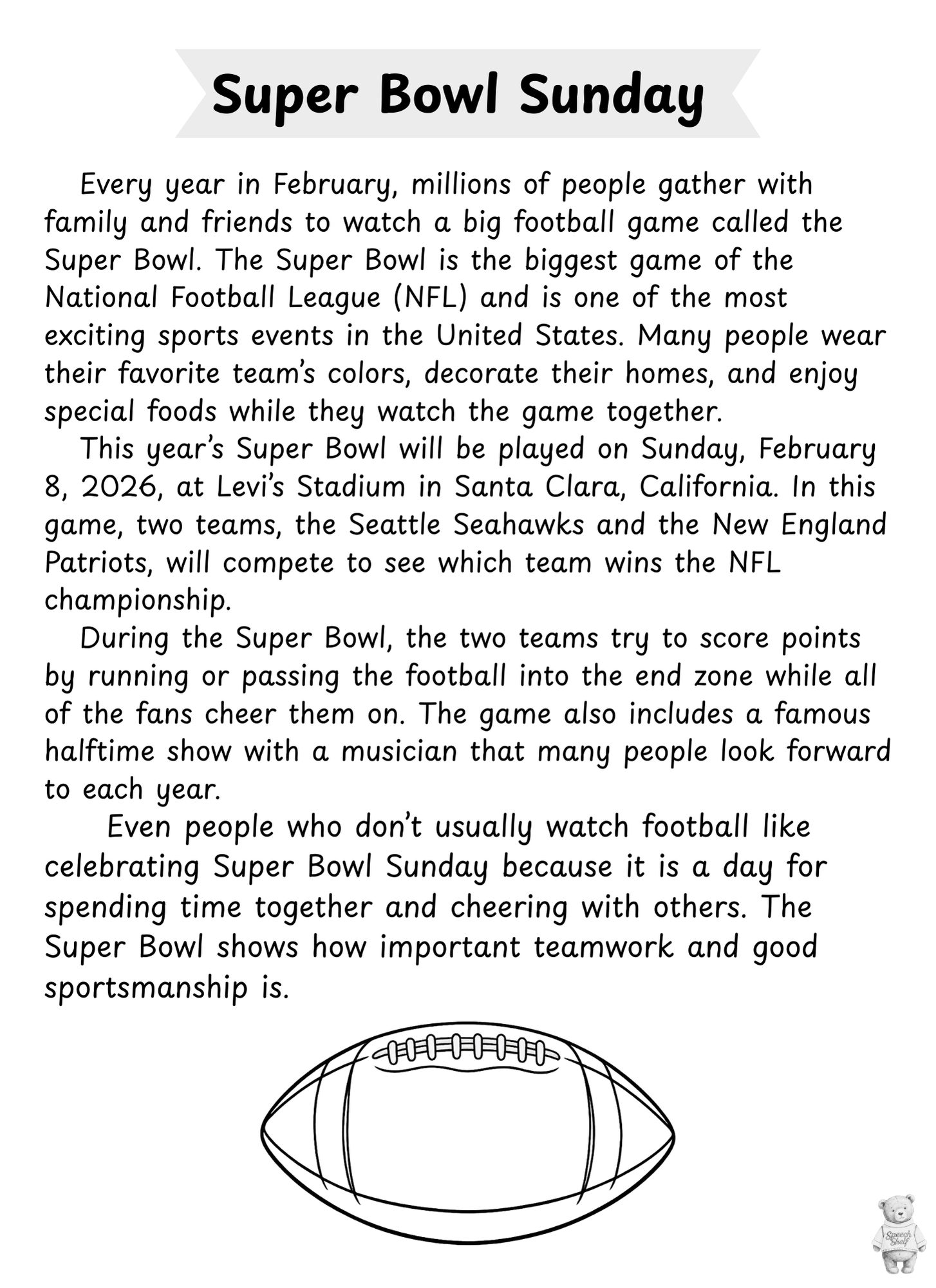
Super Bowl Passage and Activities
This Super Bowl Sunday resource includes a simple reading passage, comprehension questions, sequencing practice, and a prediction page to support language and literacy skills. Students can learn about the football tradition while working on answering WH questions, ordering events, and explaining their thinking in writing.
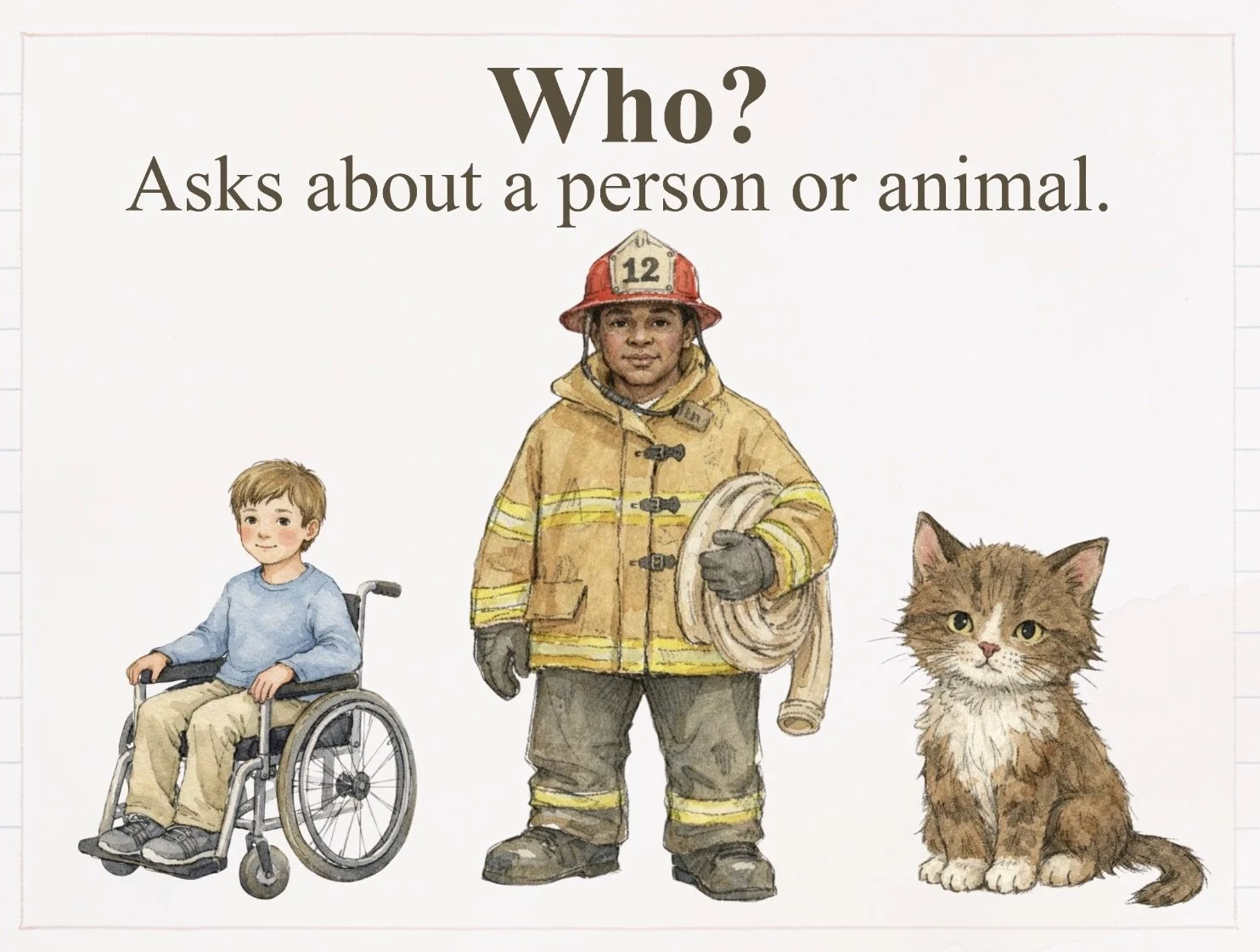
"WH" Questions Décor/Visual Supports
These WH-question posters provide clear, explanations of who, what, when, where, why, and how using simple language and engaging visuals. They can be used as functional visual supports during therapy or displayed as educational décor in your speech room.
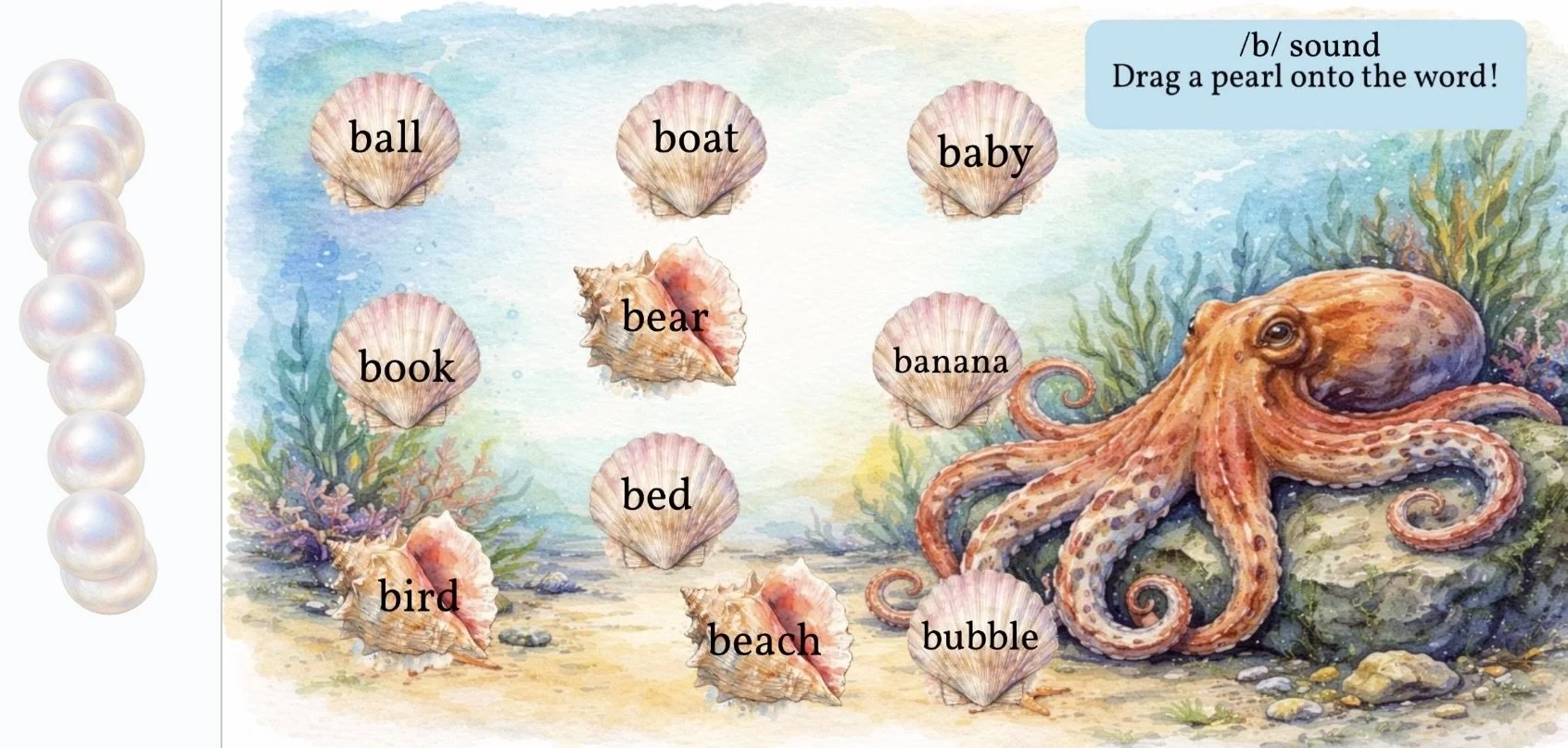
Ocean Adventures in Speech
Ocean Adventures in Speech is an under-the-sea themed therapy resource targeting articulation, compare & contrast, and sentence expansion in one engaging activity pack. Students practice a wide range of speech sounds and language skills through drag-and-match word trials, describing pictures, and identifying similarities and differences using consistent visual prompts. The 35-slide deck includes 19 articulation boards, 5 compare-and-contrast activities, and 10 picture description prompts.
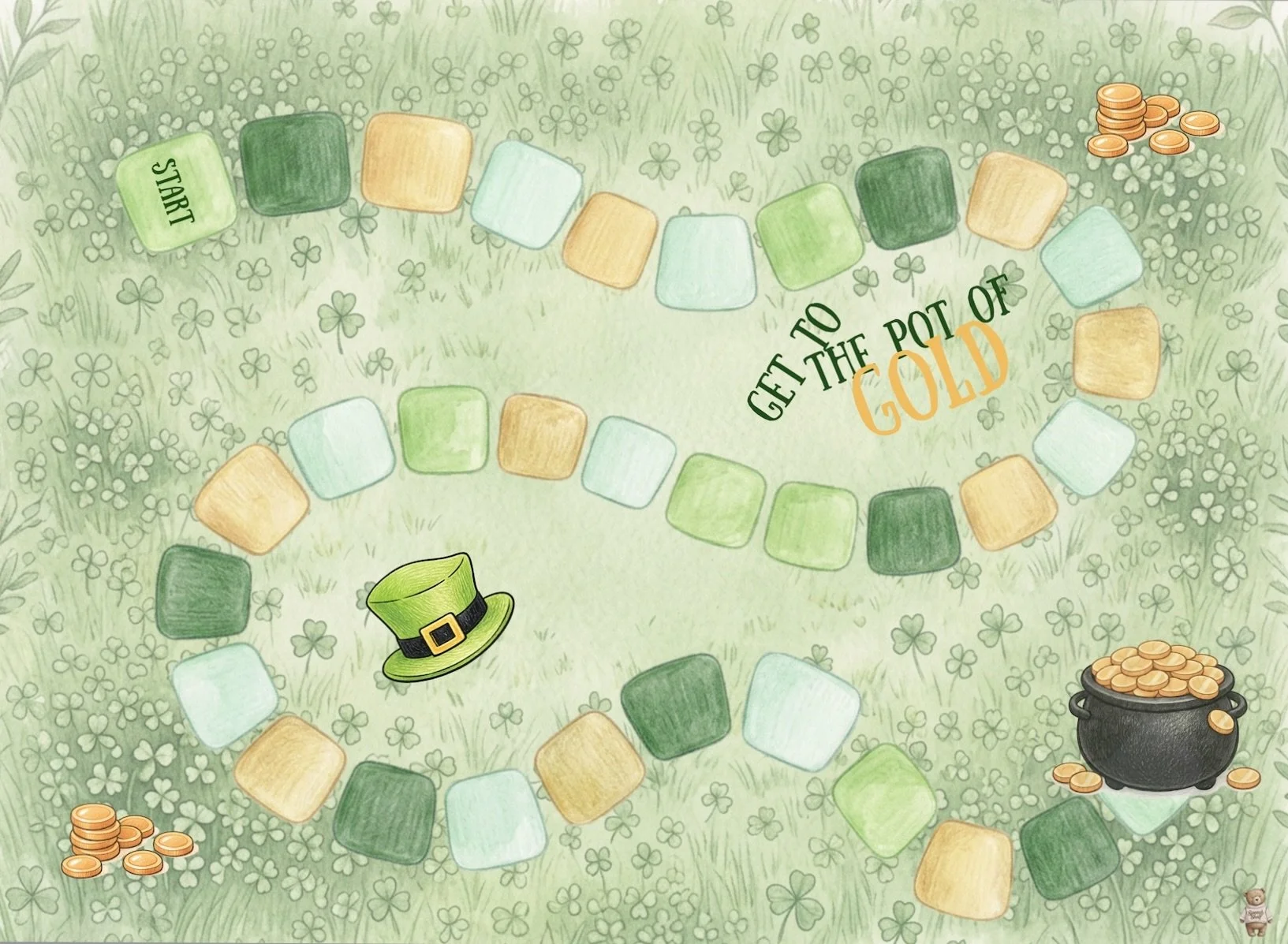
Open-Ended St. Patrick's Day Board Game
This St. Patrick’s Day themed board game can be used for open-ended speech and language activities such as articulation practice, WH-questions, vocabulary, or conversation prompts. Students move along the path toward the pot of gold while completing therapy trials, making it an engaging way to target a variety of communication goals.
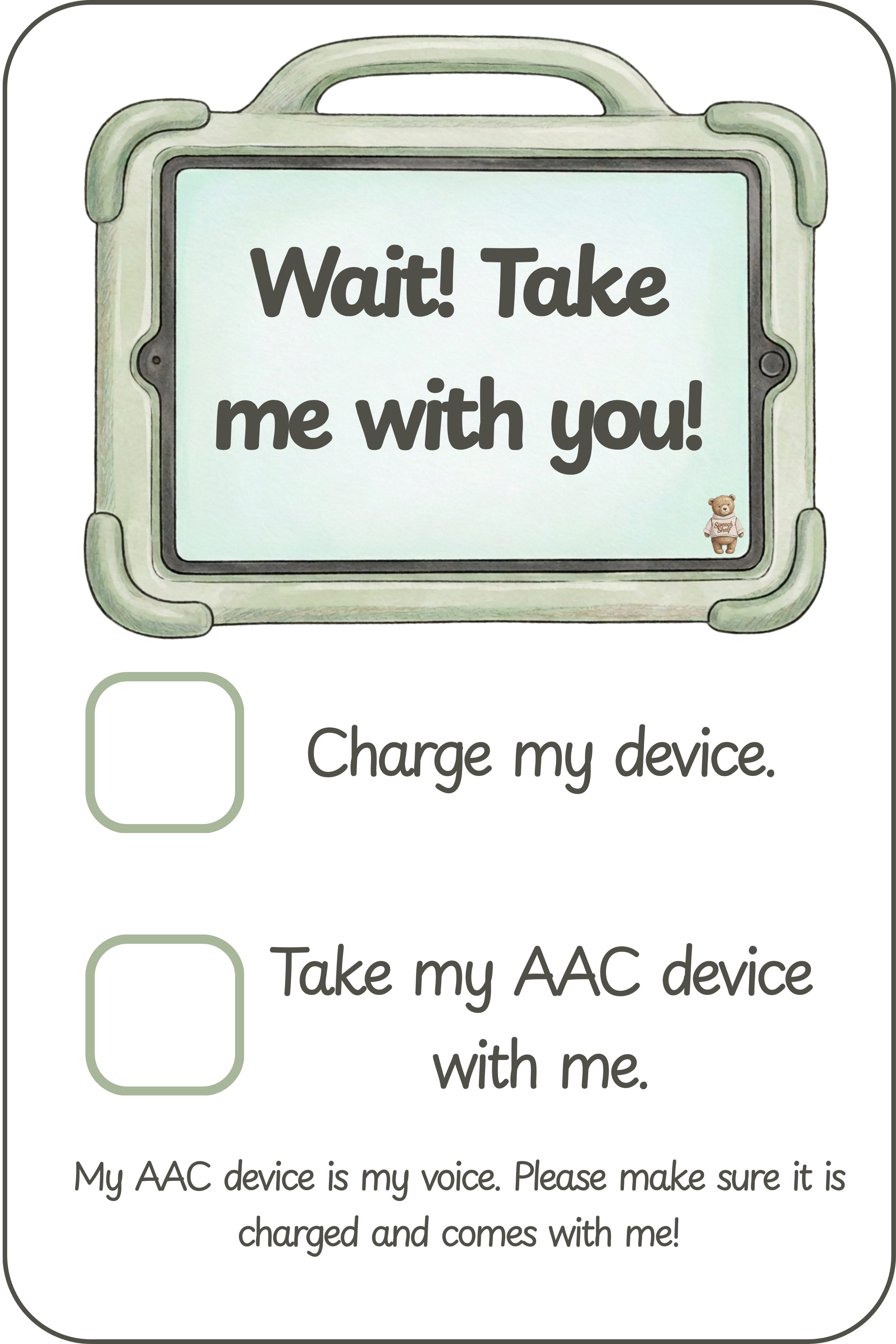
AAC Checklist Card
This AAC reminder card helps ensure a client’s communication device is charged and sent with them throughout the day. The visual checklist provides a simple reminder for caregivers or staff to charge the device and bring it along so the client always has access to their voice.
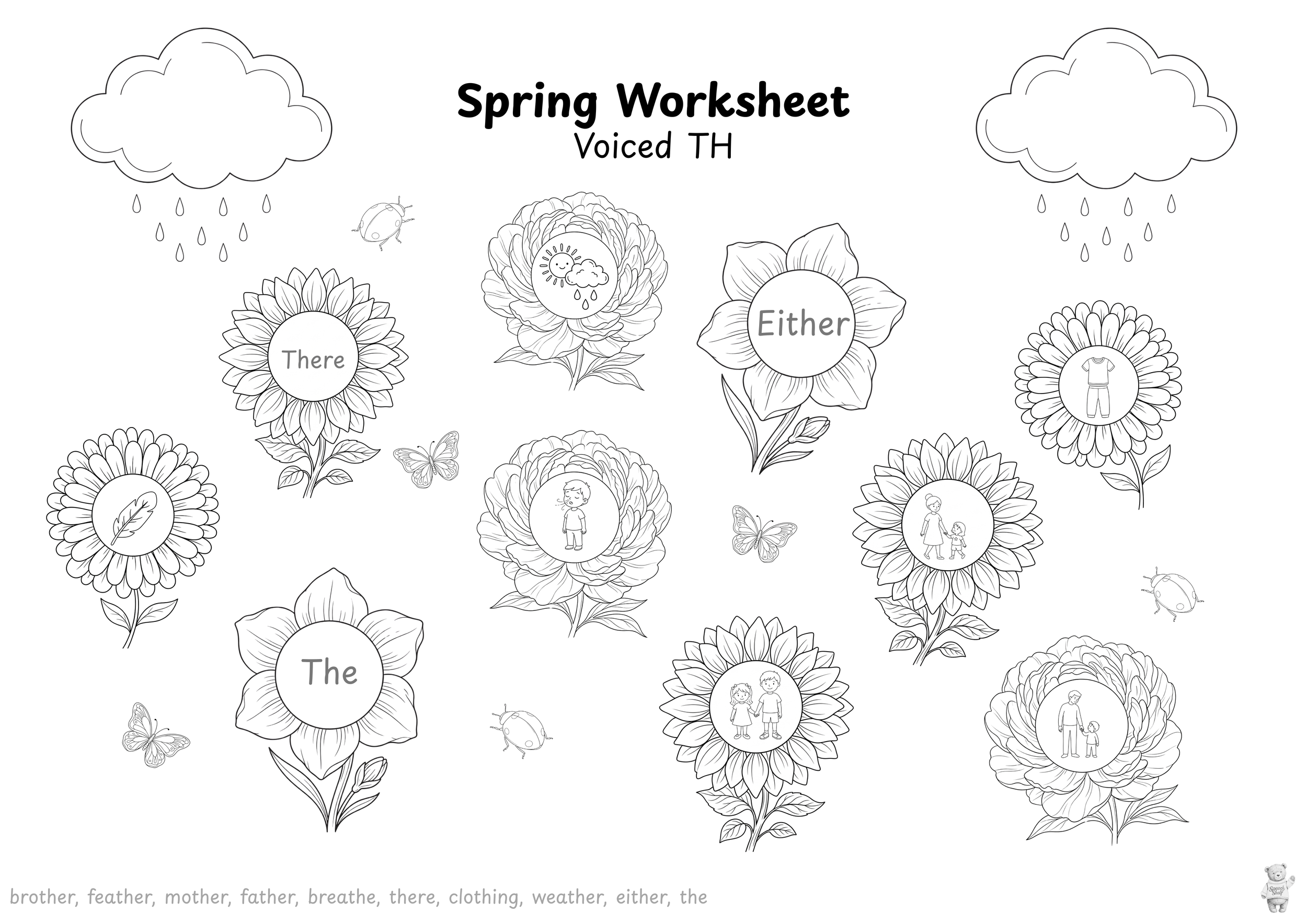
Spring Speech and Language Pack
Spring-themed articulation and language worksheets featuring 18 pages of different no-prep targets designed to address key speech sounds, verbs, pronouns, and vocabulary in an engaging, child-friendly way. Perfect for SLPs and graduate students, this resource supports structured practice while keeping sessions fun, organized, and effective.
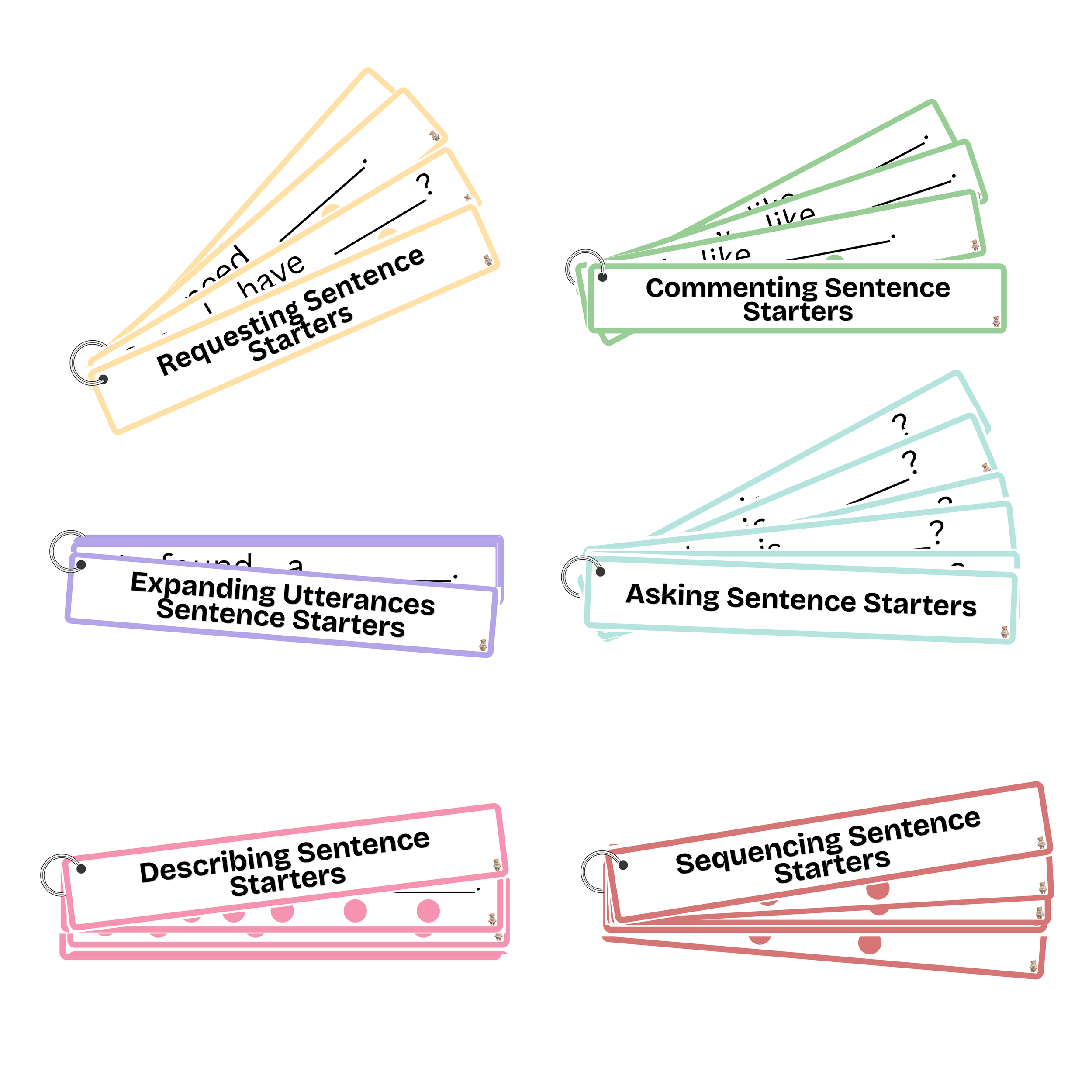
6-pack Sentence Starter Visuals
This resource includes a 6-pack set of sentence starters designed to support students in requesting, commenting, asking, describing, expanding utterances, and sequencing. Dots are included under each sentence to guide student tracking and participation, and the strips can be laminated for repeated use with dry-erase markers, promoting independence and ongoing language practice.
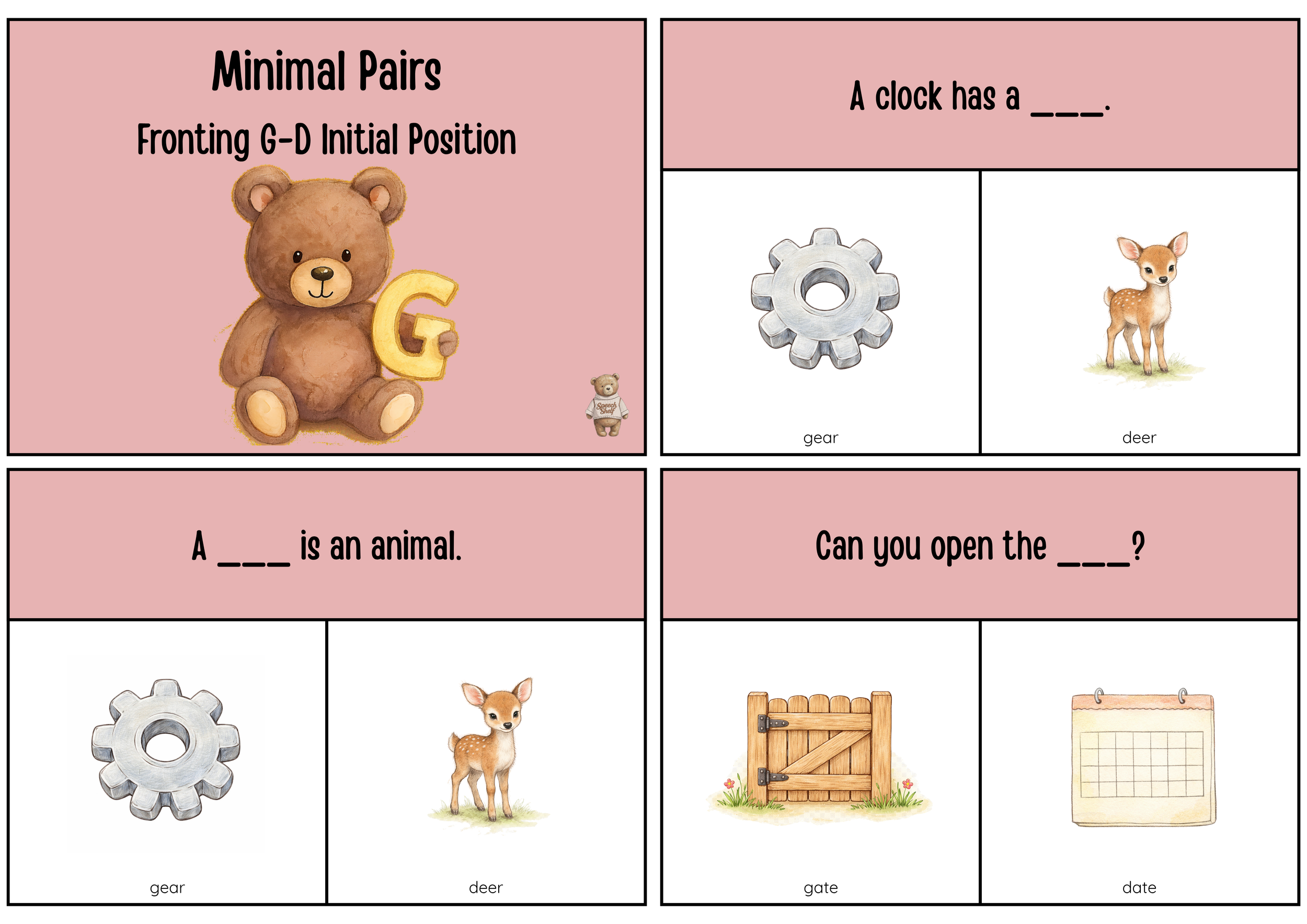
Minimal Pairs Fronting G-D Initial Position
This interactive minimal pairs activity targets fronting of /g/ to /d/ in the initial word position, using high-quality, child-friendly illustrations to support speech perception and production. Students are presented with picture-supported sentences and must choose the correct minimal-pair target (e.g., gear–deer, gate–date, go–dough, gull–dull, gown–down, gaze–daze). Each card includes a simple sentence prompt (e.g., “A clock has a ___,” “Can you open the ___?” “Green means ___”).
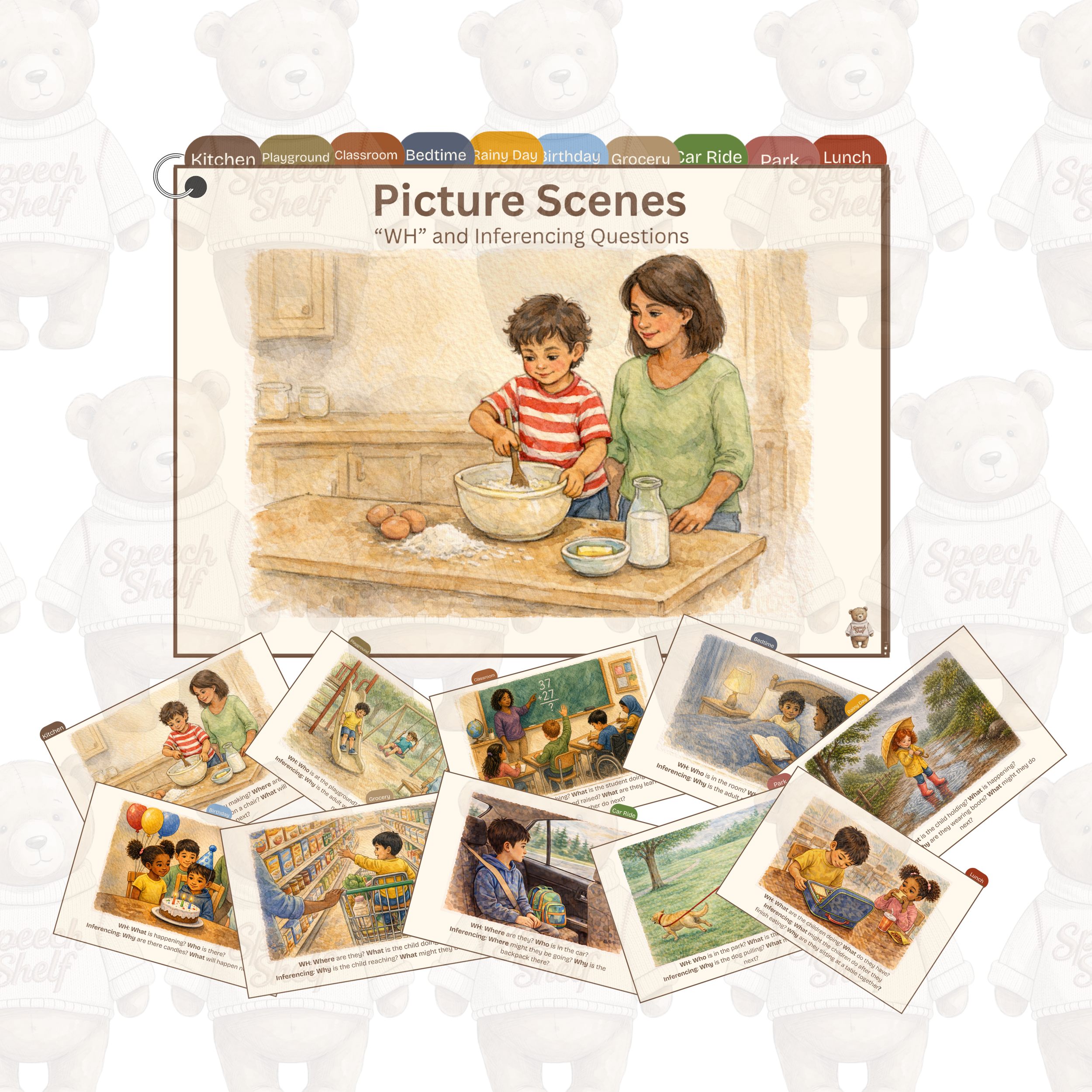
Picture Scenes- “WH” and Inferencing Questions
Picture Scenes for WH Questions & Inferencing is a no-prep, ready-to-use language activity designed to target multiple goals within a single session. This resource includes engaging, child-friendly picture scenes (e.g., kitchen, playground, classroom, grocery store, lunchroom, and more) paired with simple WH questions and higher-level inferencing questions. Includes 10 picture scenes with tabs for navigation!
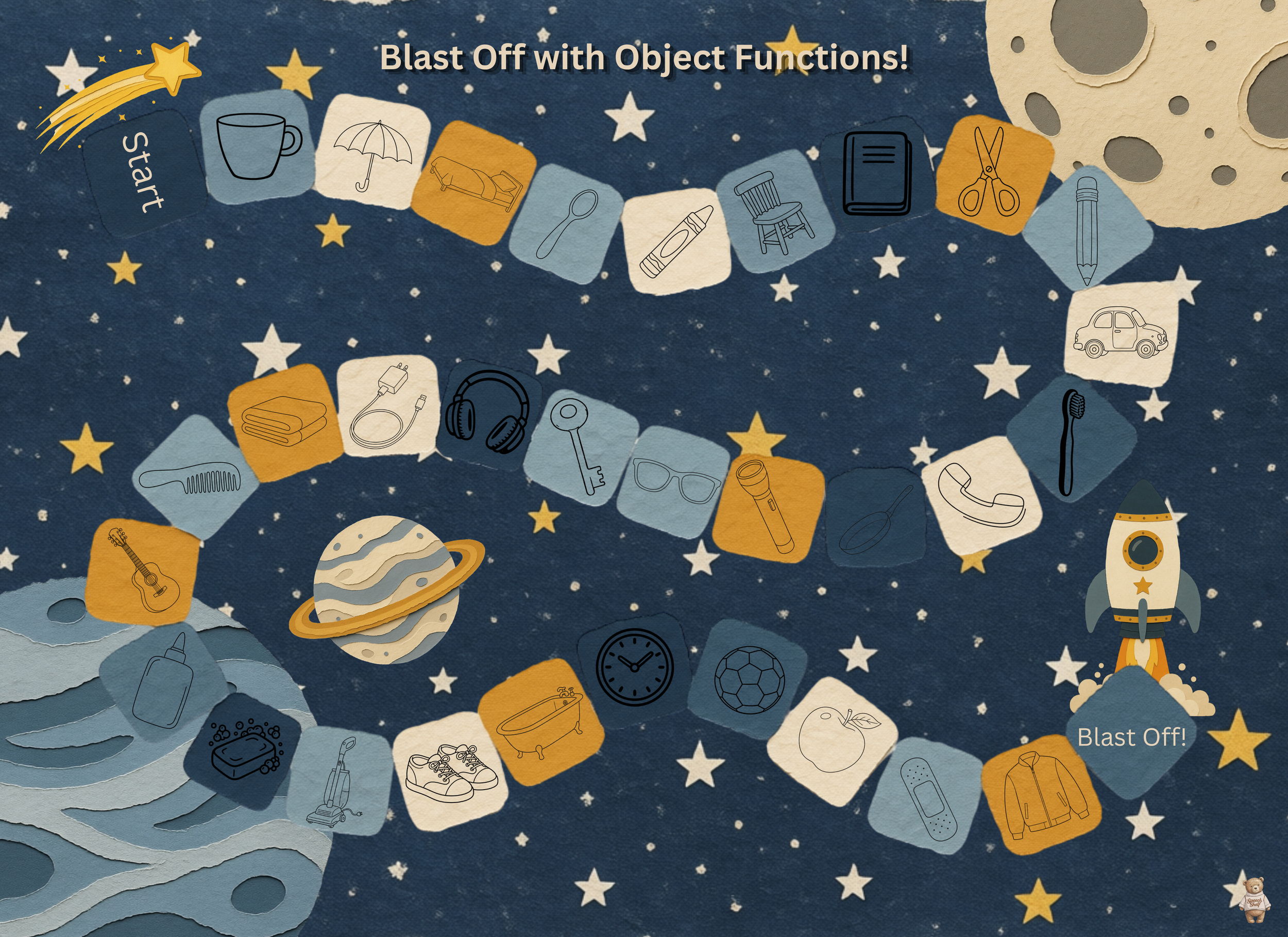
Blast Off with Speech!
Blast Off in Speech: Speech and Language Deck is a fun, space-themed board game designed to target object functions, categories, and open-ended targets in an engaging way. Students move around the board while identifying what objects are used for and sorting or naming categories like food, clothing, and animals, making it perfect for building foundational vocabulary and language skills. This resource includes two targeted boards (Categories and Object Functions), an empty open-ended board that can be used with any goal of your choice, and an articulation pack that is automatically included in the slides upon download, featuring additional boards that target /k/, /g/, /f/, /s/, /sh/, /ch/, /th/, prevocalic /r/, and blends (r-blends and l-blends). Just print and play for an easy activity that keeps clients engaged.
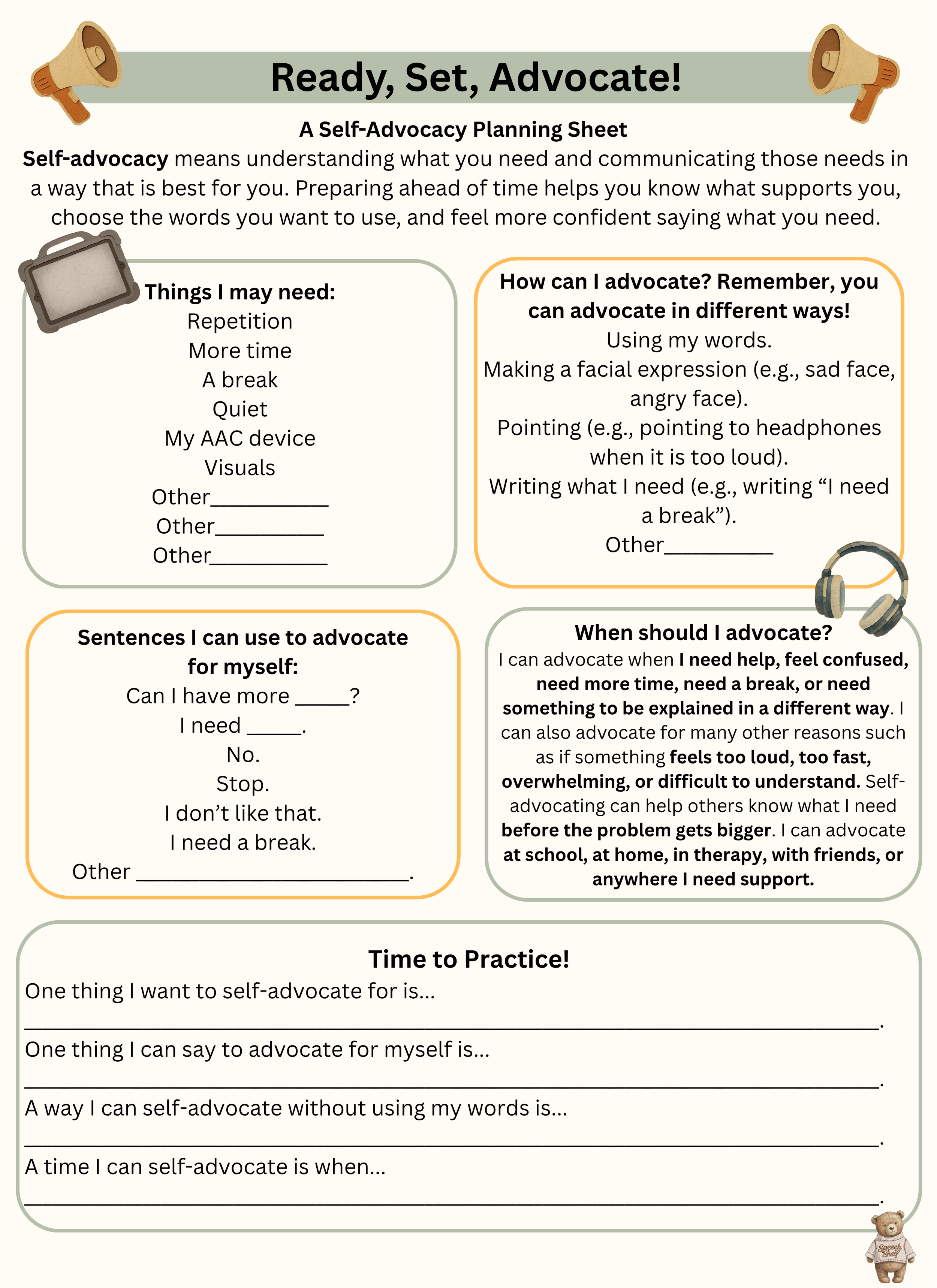
Ready, Set, Advocate!
Self-advocacy is such an important skill, but it is not always explicitly taught. This resource gives older clients, parents, and caregivers a clear way to talk about what self-advocacy can look like across different situations. Ready, Set, Advocate! is a self-advocacy planning sheet designed to help clients identify what they need, learn different ways to communicate those needs, and practice advocating with confidence. This sheet is a great tool for speech therapy, classroom support, home carryover, or parent/student conversations. It can help students better navigate moments when they feel confused, overwhelmed, rushed, misunderstood, or in need of support.
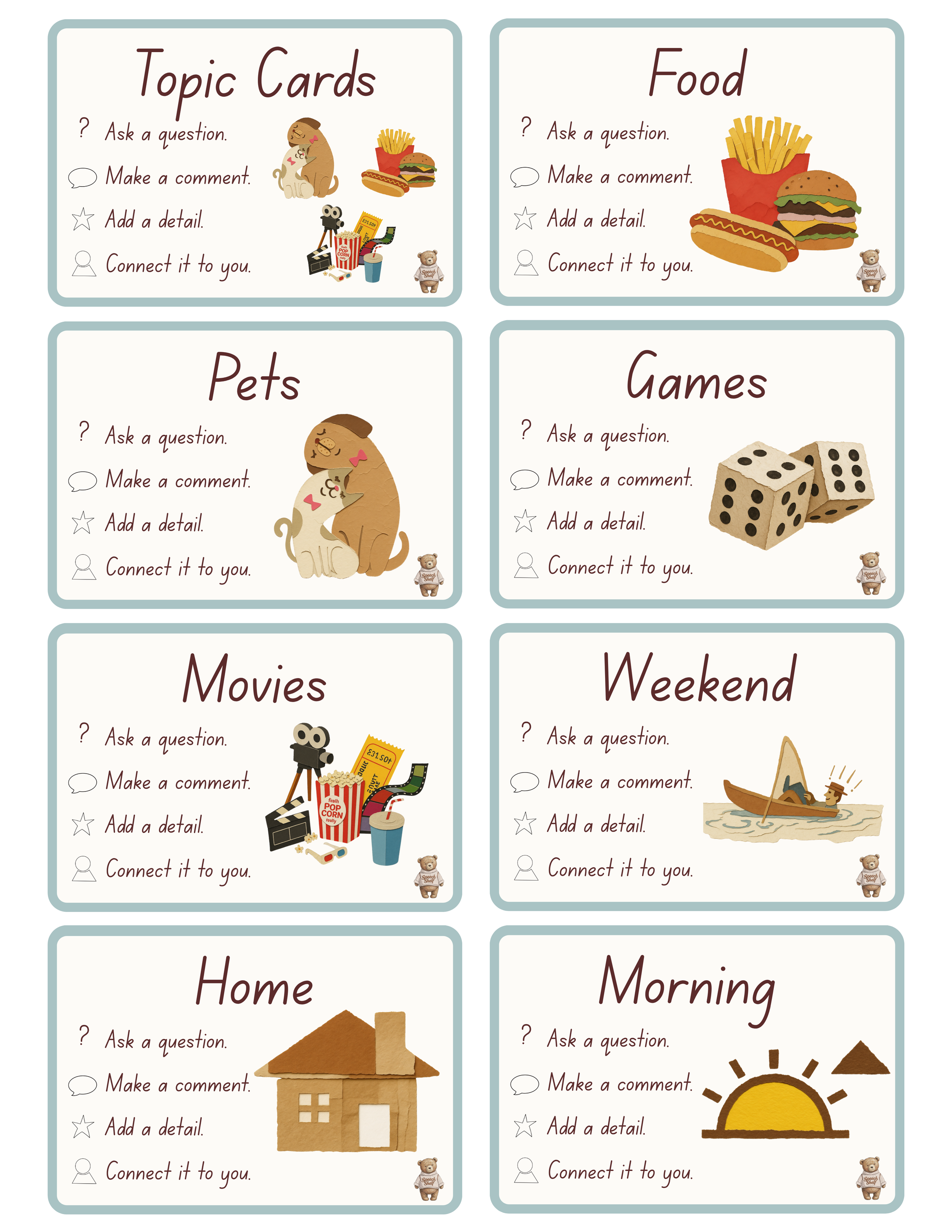
Conversation Topic Cards
These Conversation Topic Cards include 23 familiar, engaging topics with visual support and simple conversation prompts. Clients can practice asking questions, making comments, adding details, and making personal connections while building expressive language and social communication skills. Great for speech therapy sessions, social groups, or quick conversation warm-ups.
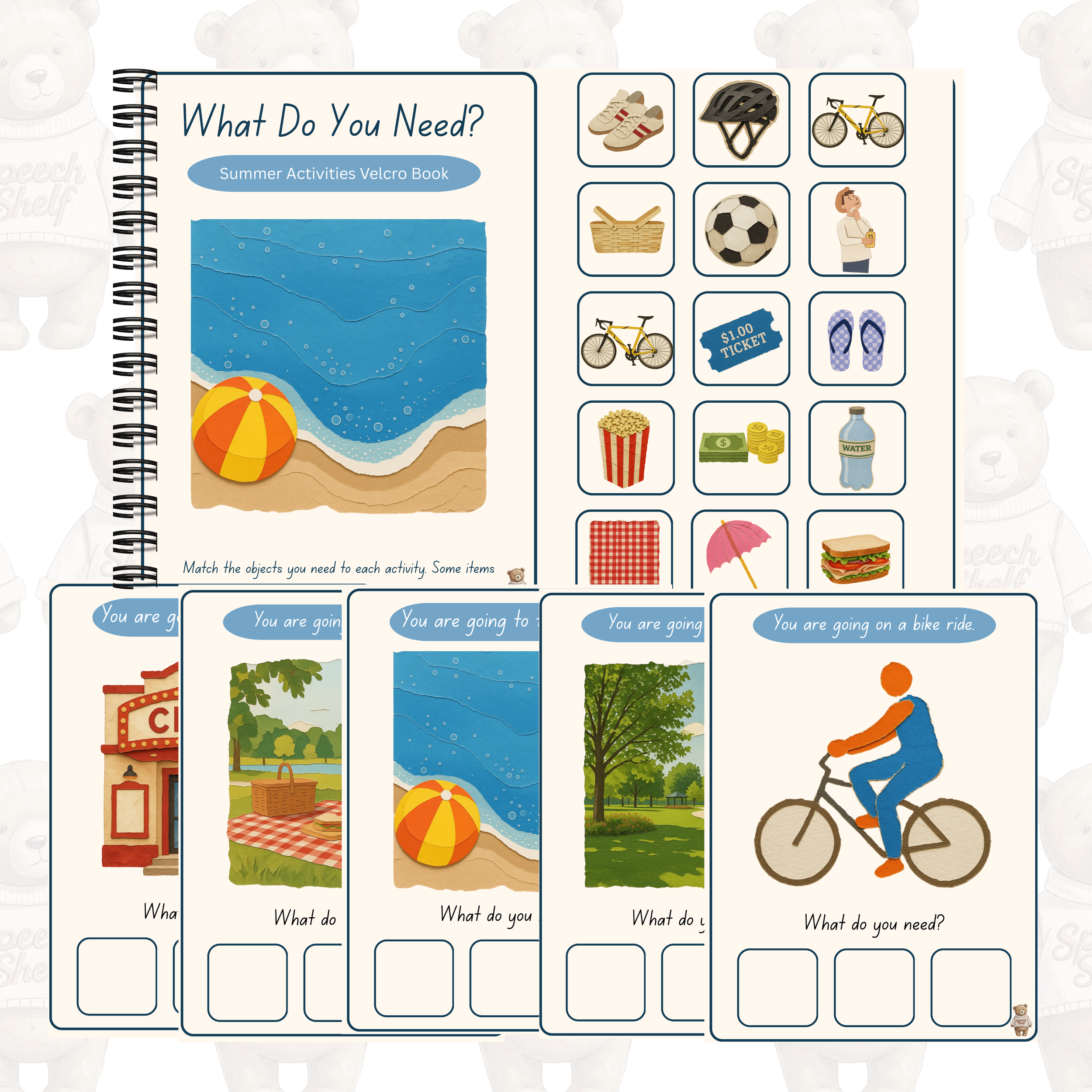
Summer Velcro Book-What Do You Need?
Summer-What Do You Need? Velcro Book is a fun, functional activity for targeting vocabulary, categories, WH-questions, object functions, and reasoning. Students choose what items they need for different summer activities. Some items can be used for more than one activity, such as a water bottle or sneakers. This helps students practice flexible thinking and explain their answers.
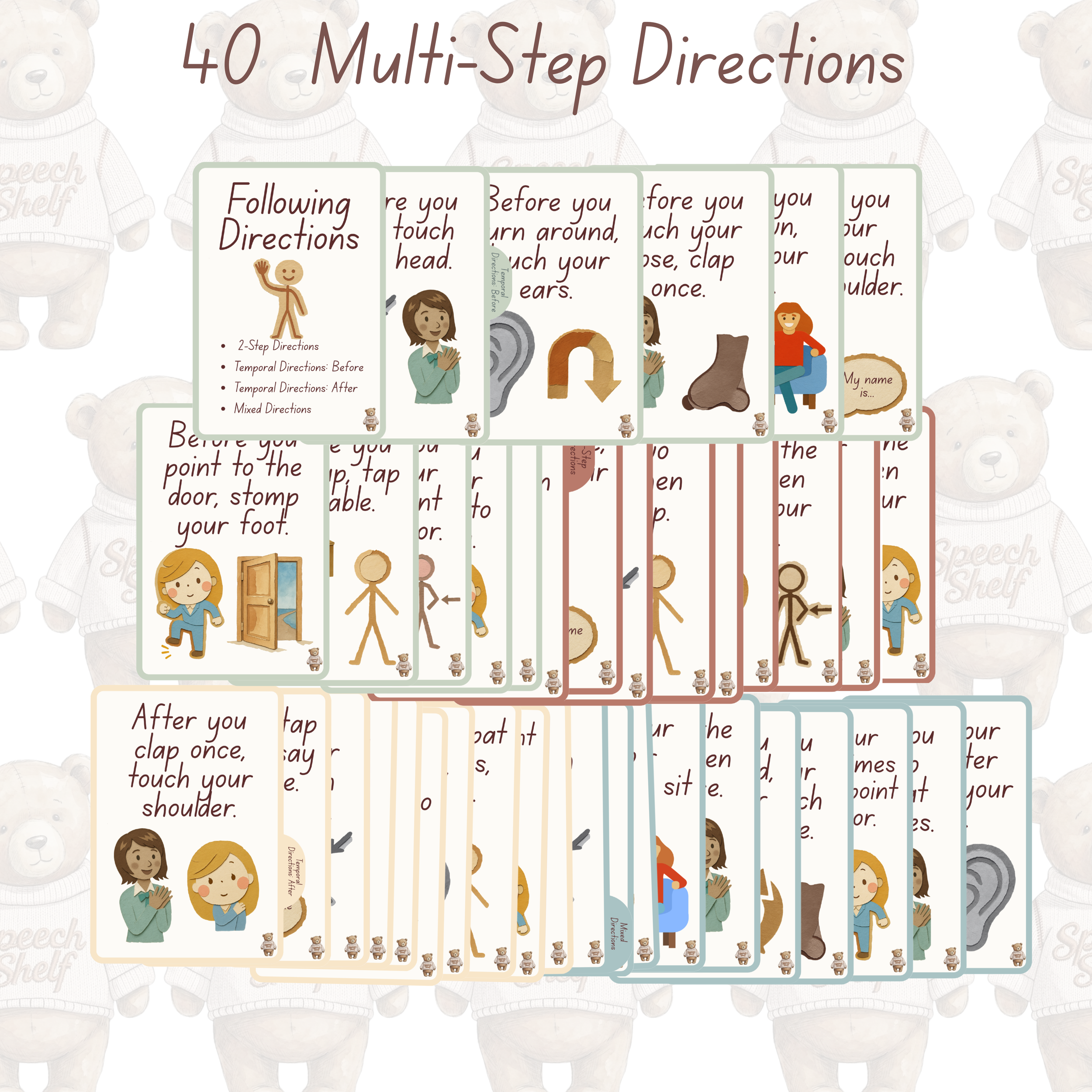
Following Multi-Step Directions
Strengthen listening comprehension, auditory memory, sequencing, and temporal concepts with this low-prep activity featuring 40 multi-step directions. Contains tabs on sides of cards for easy navigations.
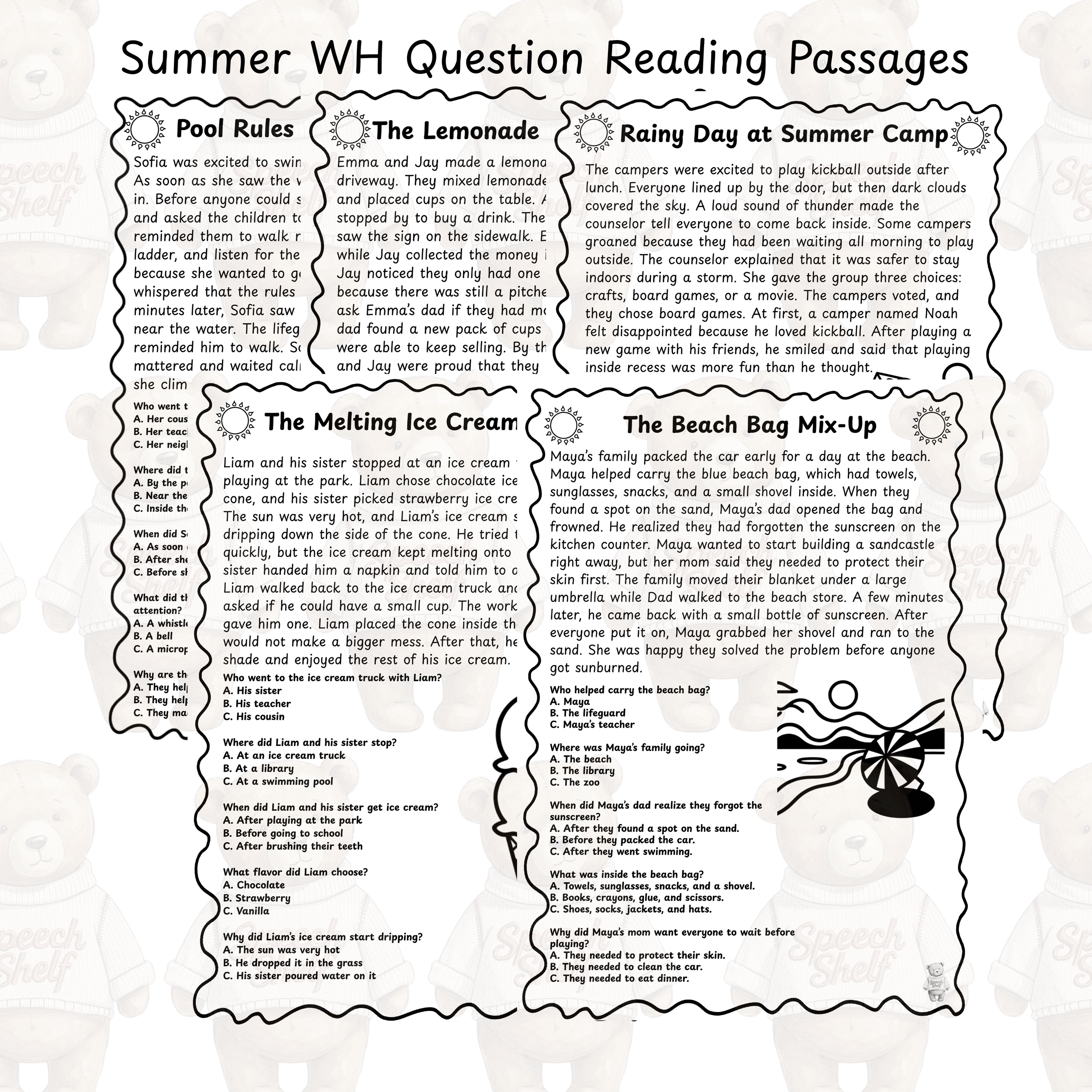
Summer WH Question Reading Passages
Target reading comprehension, auditory comprehension, and WH questions with this 5-page summer-themed speech therapy resource. Each short passage includes multiple-choice “WH” questions to support clients working on answering questions, recalling details, making inferences, and understanding simple problem-solving scenarios.
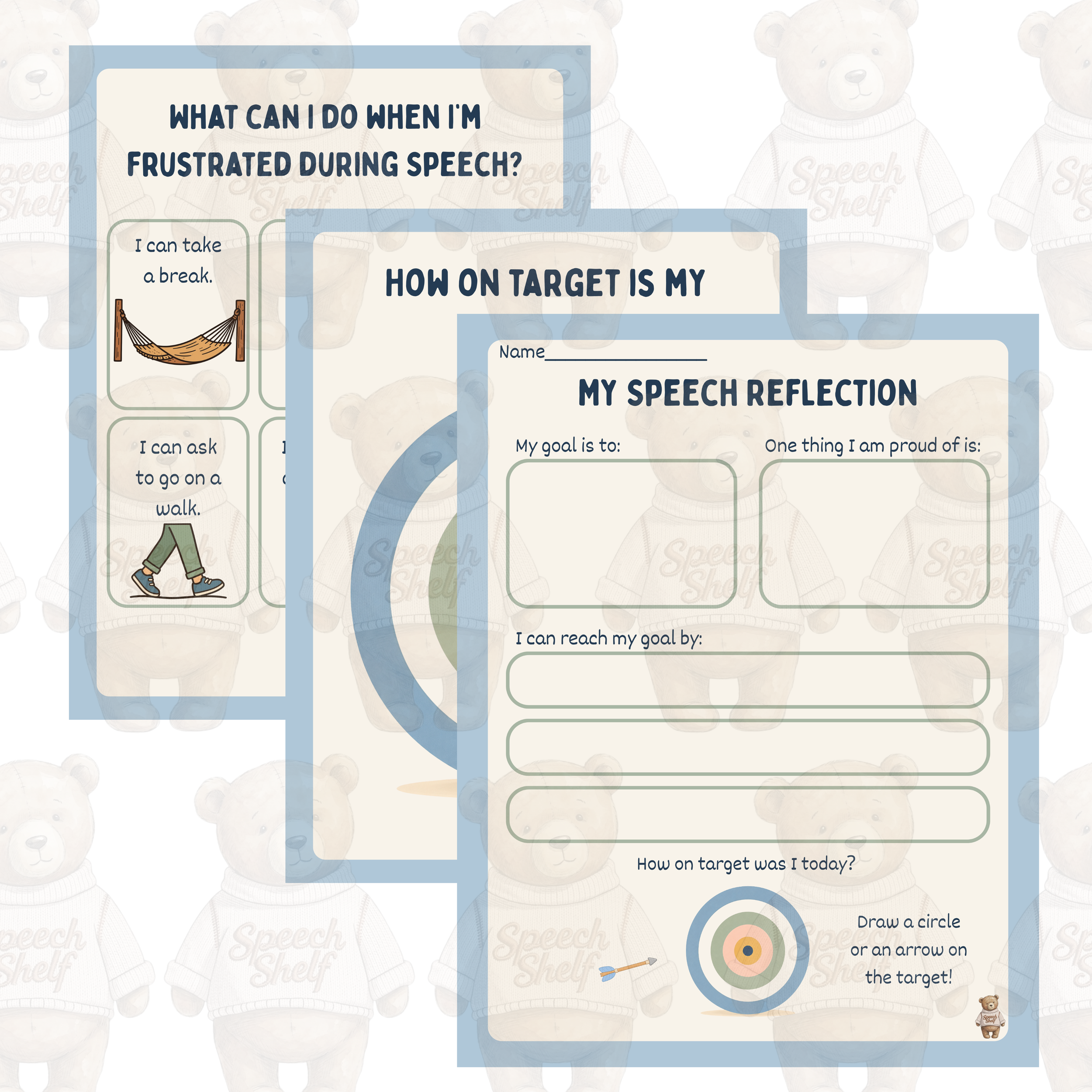
Visuals & Worksheet for Self Reflection
Help clients reflect on their speech goals with these simple, kid-friendly self-reflection visuals. This set includes a speech reflection worksheet, an “on target” speech visual, and a frustration support page with strategies clients can use during speech sessions.
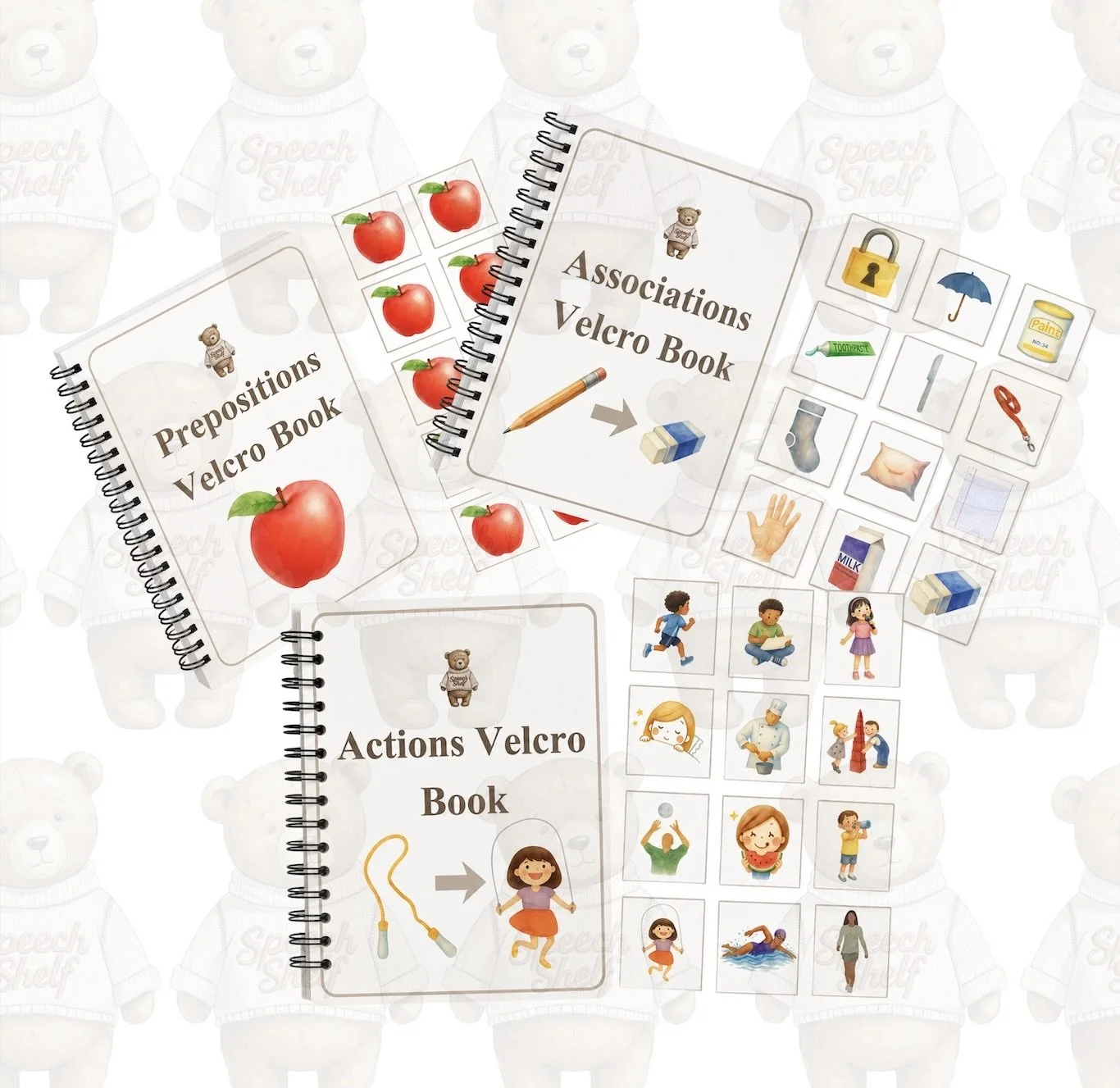
Velcro Book Pack- Actions, Associations, and Prepositions
This Velcro Book Pack includes three interactive books targeting actions, associations, and basic prepositions. Learners match picture pieces to simple prompts, identify related objects, and follow directions involving spatial concepts such as above, under, beside, between, and behind. The visual format supports receptive language, expressive language, vocabulary, sentence development, and independent task completion.
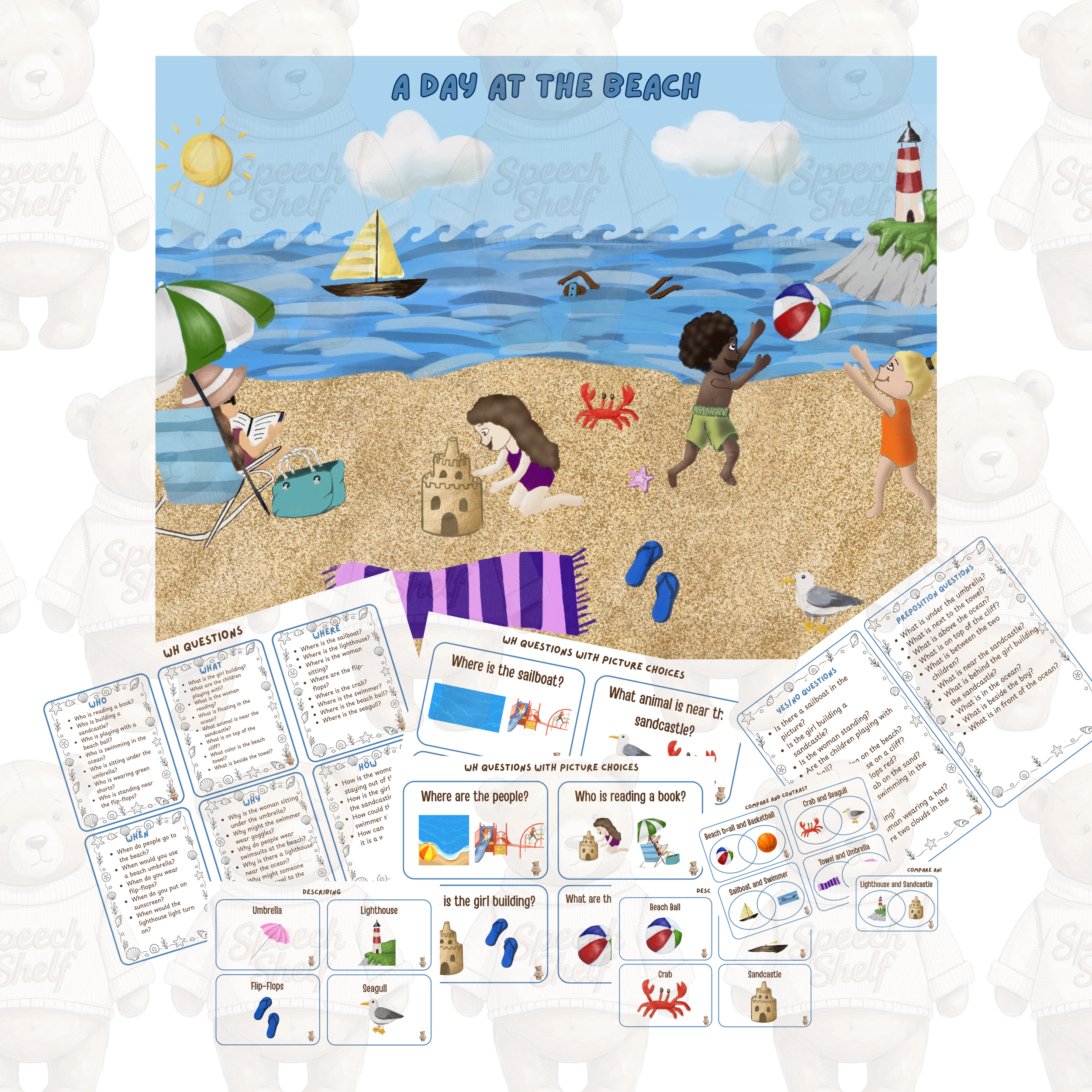
Summer Picture Scene and Language Pack
Make summer speech therapy engaging with this beach themed language resource. Students can target WH questions, yes and no questions, prepositions, following directions, describing, and compare and contrast skills using one interactive beach scene. This resource is perfect for individual or small group speech therapy sessions and supports receptive and expressive language goals.
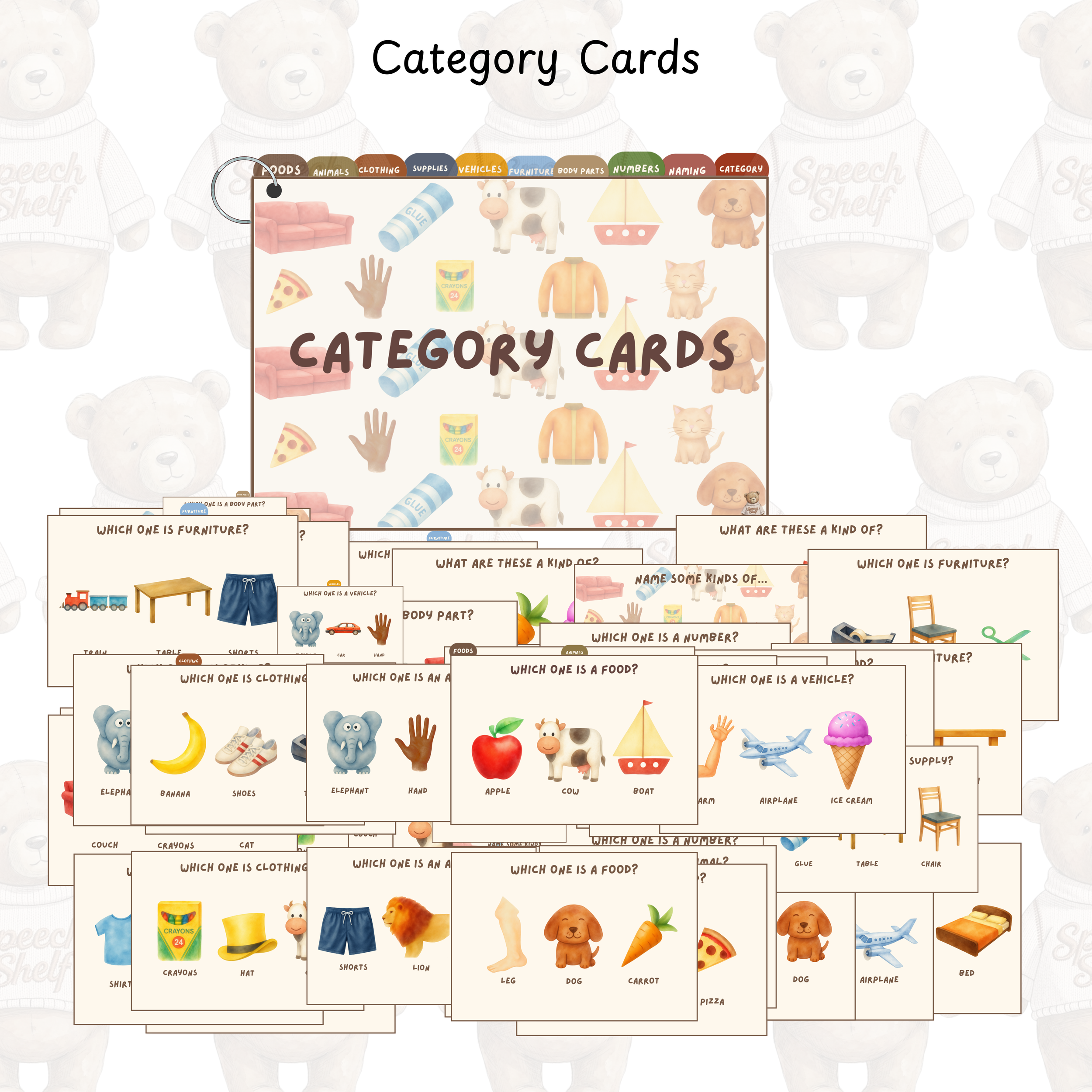
Category Cards
An engaging category card deck designed to build vocabulary, categorization, expressive, and receptive language skills. It includes foods, animals, clothing, school supplies, vehicles, furniture, body parts, and numbers, with activities for identifying categories and naming items within a category. Tabs are included throughout for quick and easy navigation between sections.
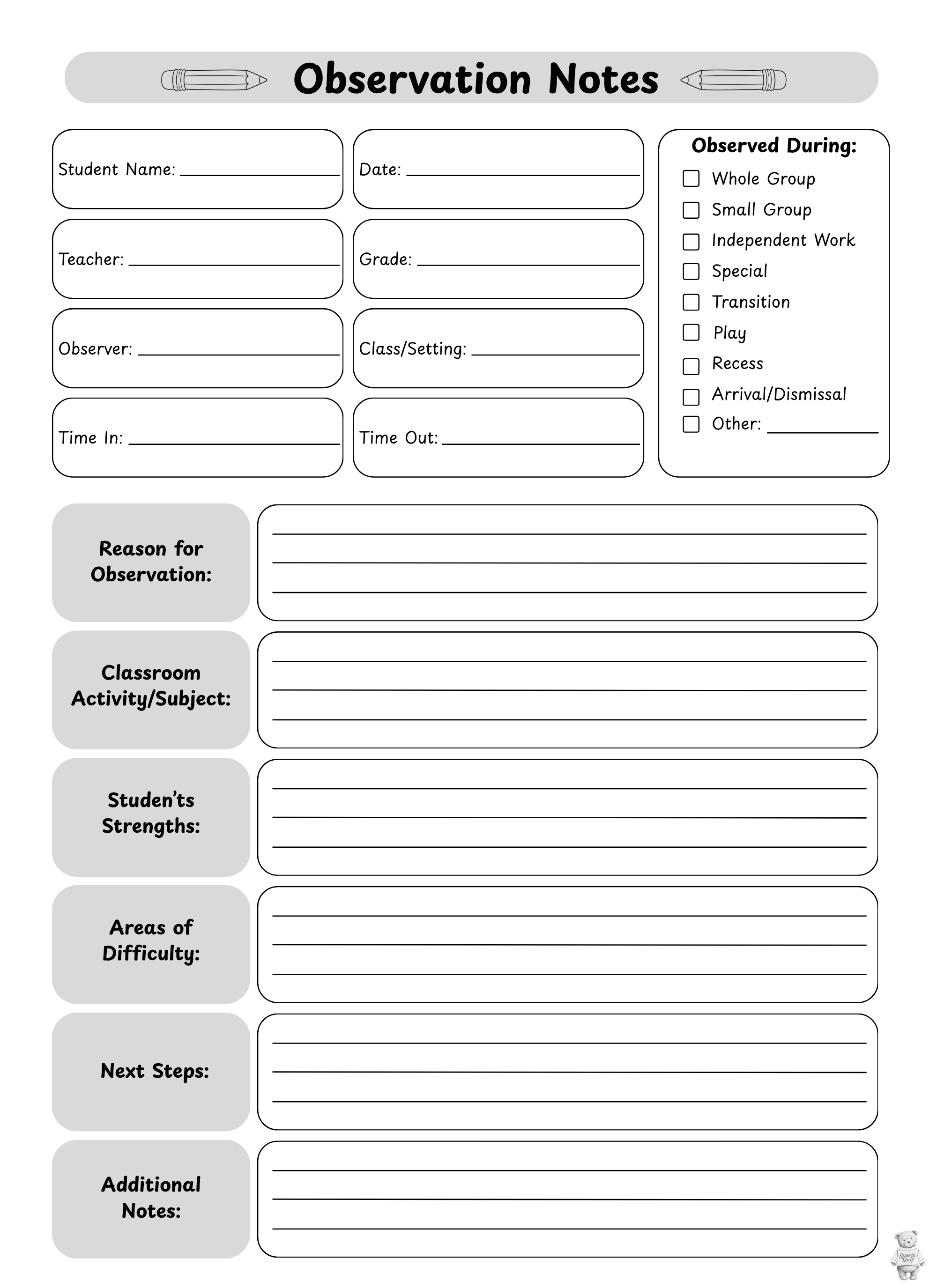
Observation Notes
An organized form for documenting observations across a variety of pediatric settings. Includes space for the observation context, reason for observation, strengths, areas of difficulty, next steps, and additional notes. Great for SLPs gathering informal information about communication, participation, and overall performance.
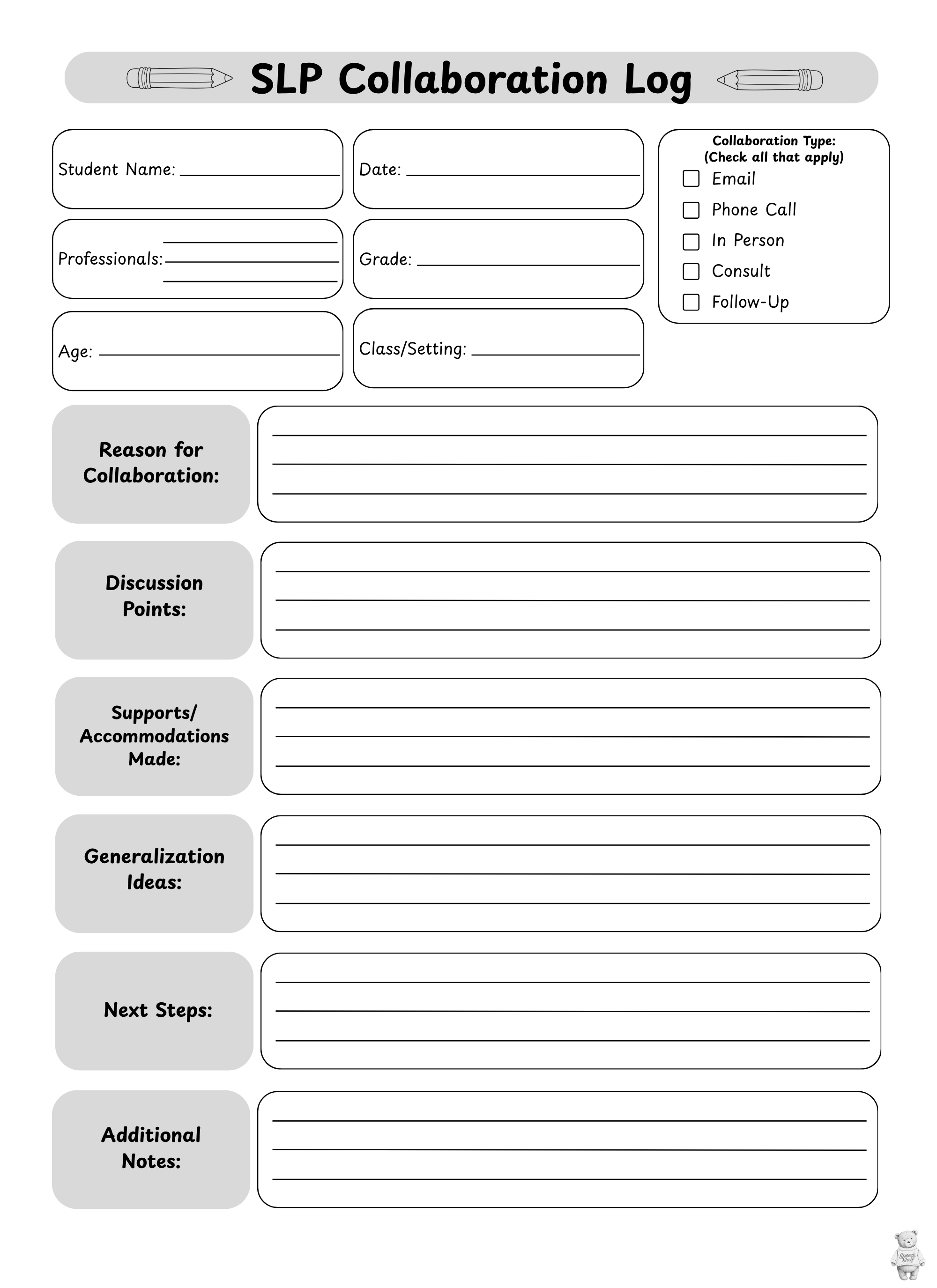
SLP Collaboration Log
An easy way to keep track of communication and collaboration with a client’s team. Document who you collaborated with, discussion points, supports or accommodations, generalization ideas, and next steps. Useful for collaborating with teachers, caregivers, related services, and more.
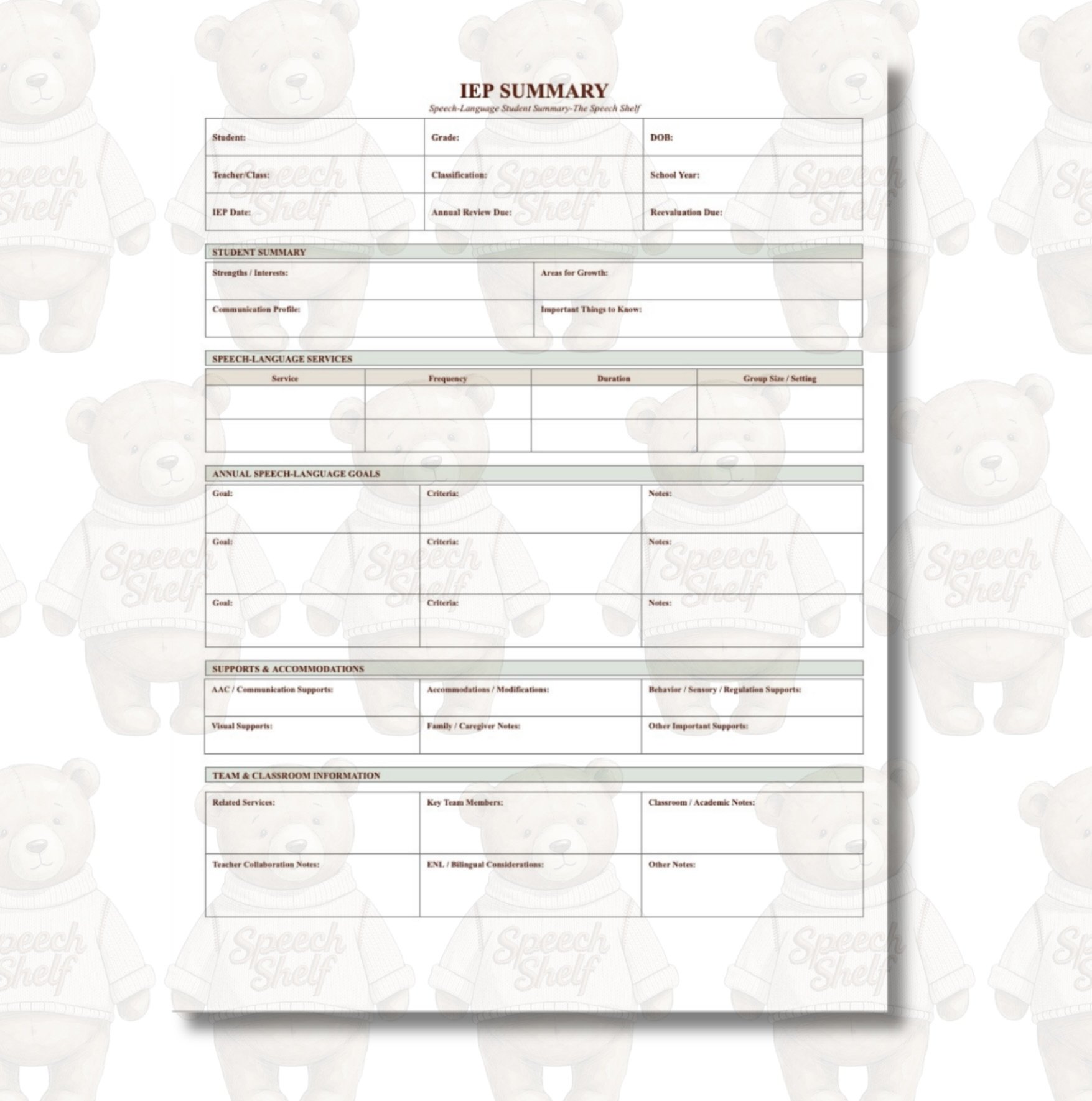
IEP Summary
This editable IEP Summary for SLPs provides a simple, organized way to keep essential student information, speech-language services, goals, supports, accommodations, and team information all in one easy-to-reference document.
Adult
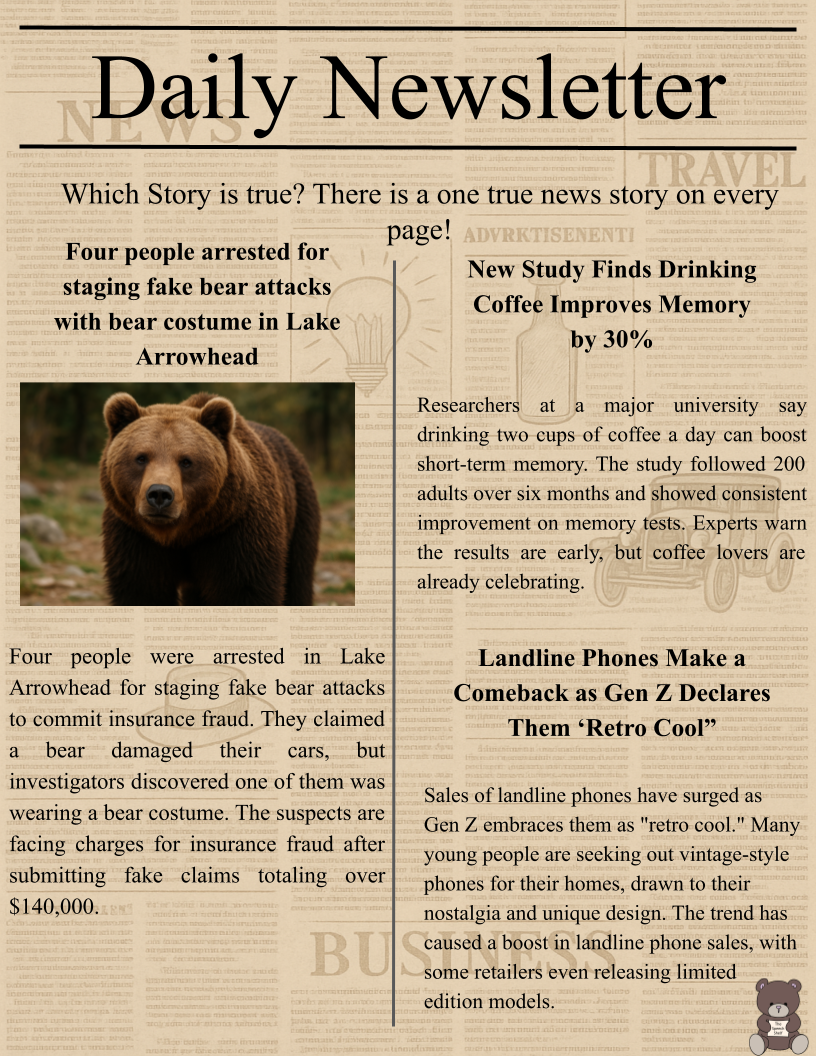
Newspaper Voice Activity
Engage your clients with this fun and interactive voice therapy activity! Each page of the newsletter features three short news stories — but only one is true. Perfect for groups like Speak Out!, this activity encourages reading aloud, discussion, and critical thinking while keeping sessions lively and motivating. An answer key is included at the end for easy facilitation.
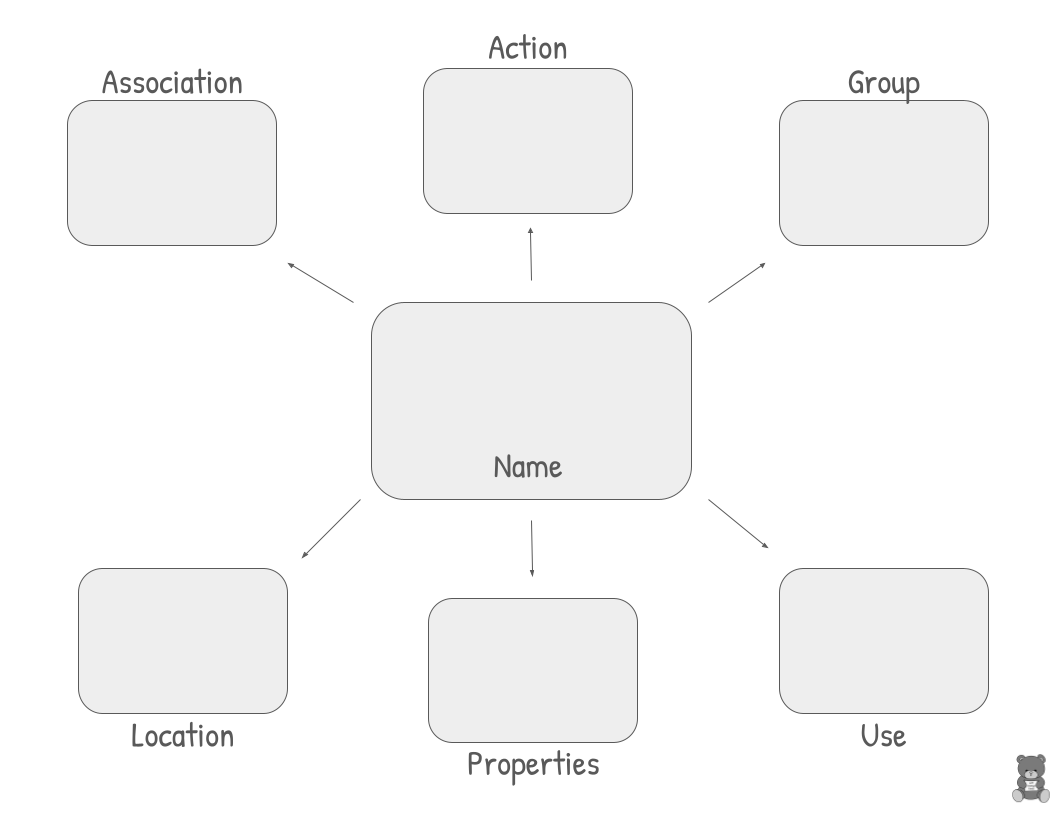
Semantic Feature Analysis (SFA)
This Semantic Feature Analysis (SFA) graphic organizer is a powerful tool for expanding vocabulary, word retrieval, and comprehension. Students name an item and then describe it across multiple features such as group, use, action, location, properties, and associations. Perfect for aphasia therapy, language intervention, and building rich semantic networks in both children and adults.
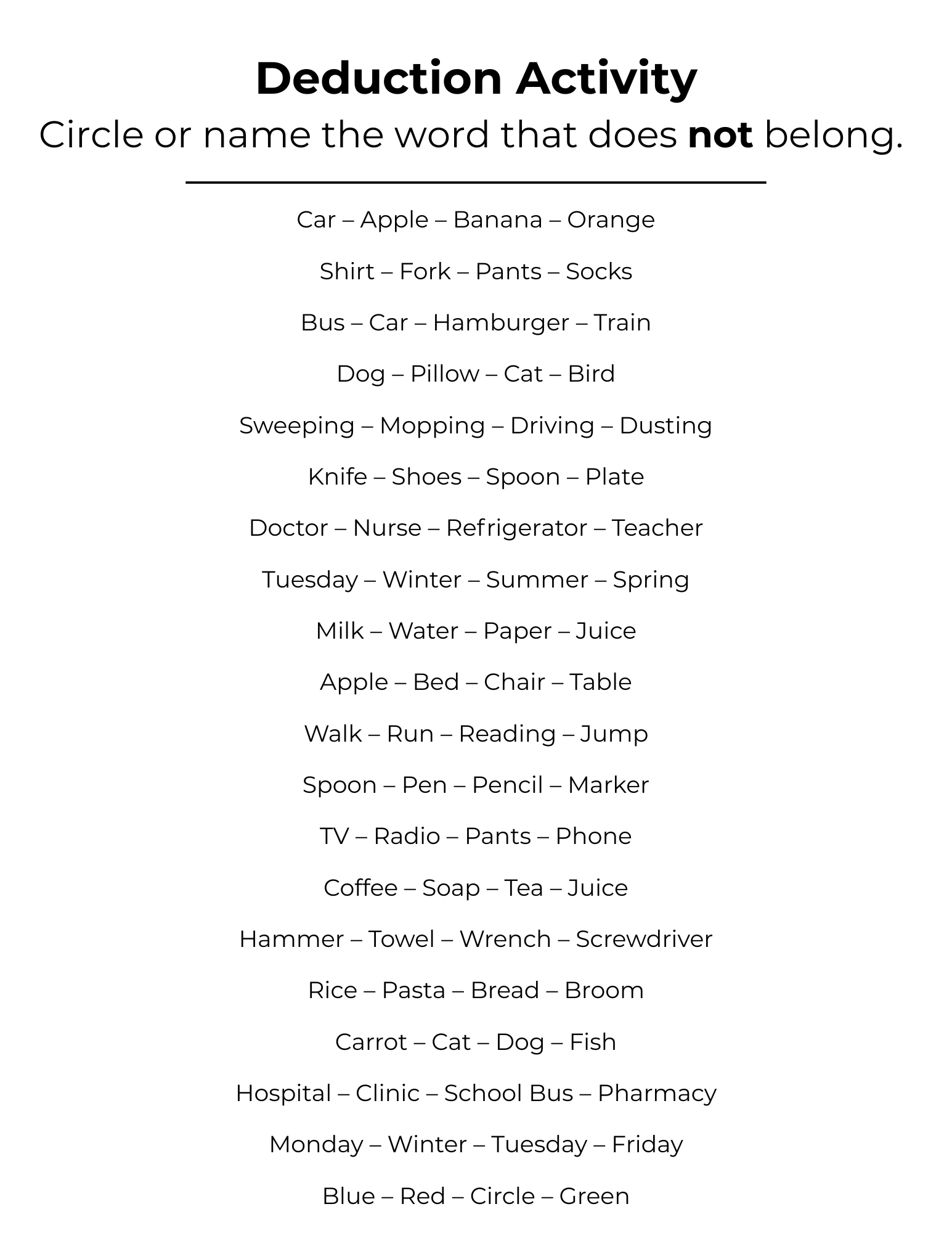
Deduction Worksheet
This worksheet targets higher-level language, reasoning, and semantic organization through a “Which one does not belong?” task. Each line contains four items, with one word that differs in category, function, or semantic features. Clients must identify the outlier by circling it or naming it aloud.
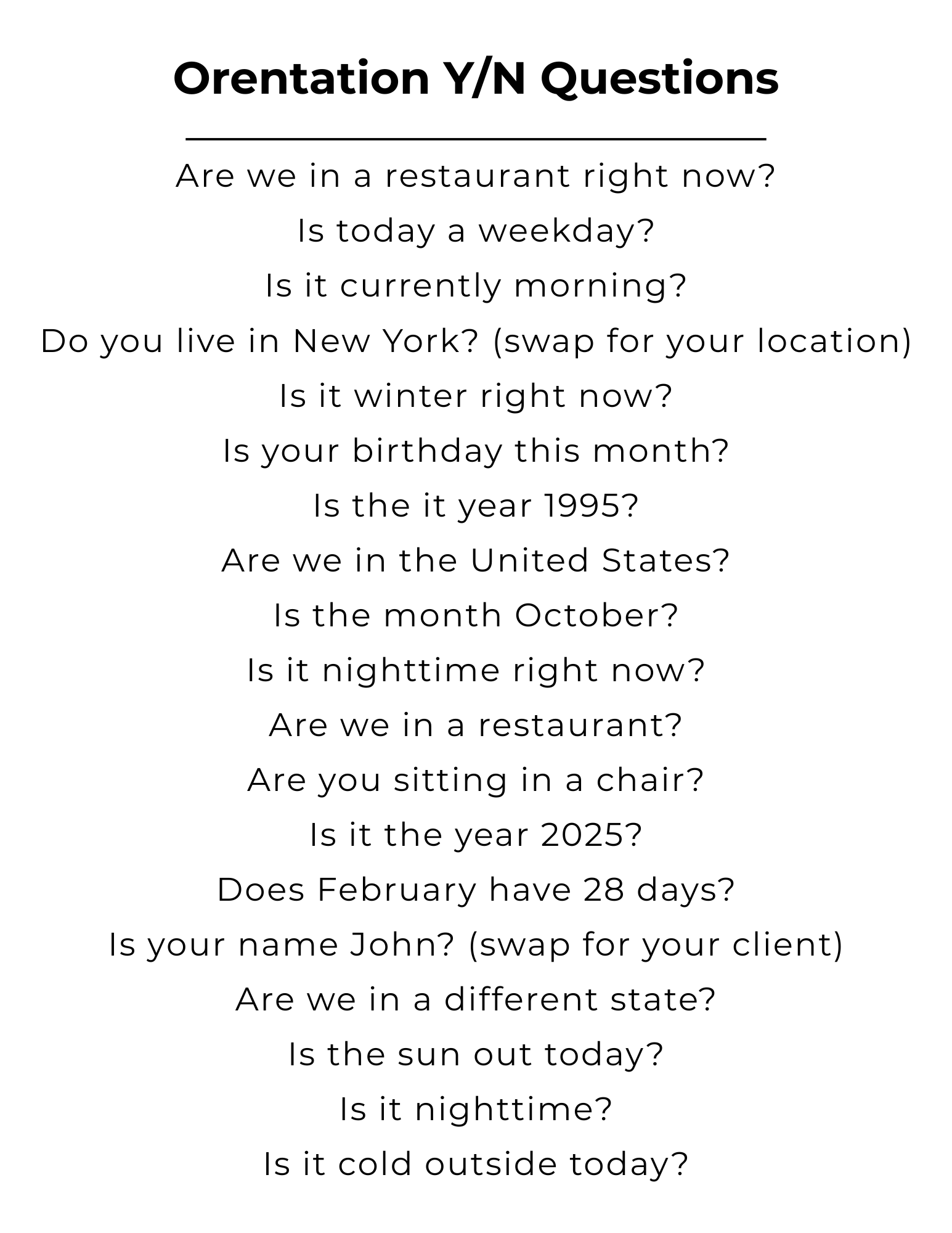
Orientation Y/N Questions
This worksheet is designed to build a client’s strength in basic orientation to person, place, time, and general knowledge using simple yes/no questions. Items target awareness of the current environment (e.g., location, time of day), personal information, seasonal knowledge, and everyday facts. Questions are written in clear, concrete language to support clients with cognitive-communication needs, memory impairments, or reduced attention.
Daily Hobby Worksheet
Help your clients, students, or residents build routine awareness, expressive language, and self-advocacy skills with this simple daily hobby worksheet.
Perfect for:
• Adult rehab
• Cognitive-communication therapy
• Executive functioning
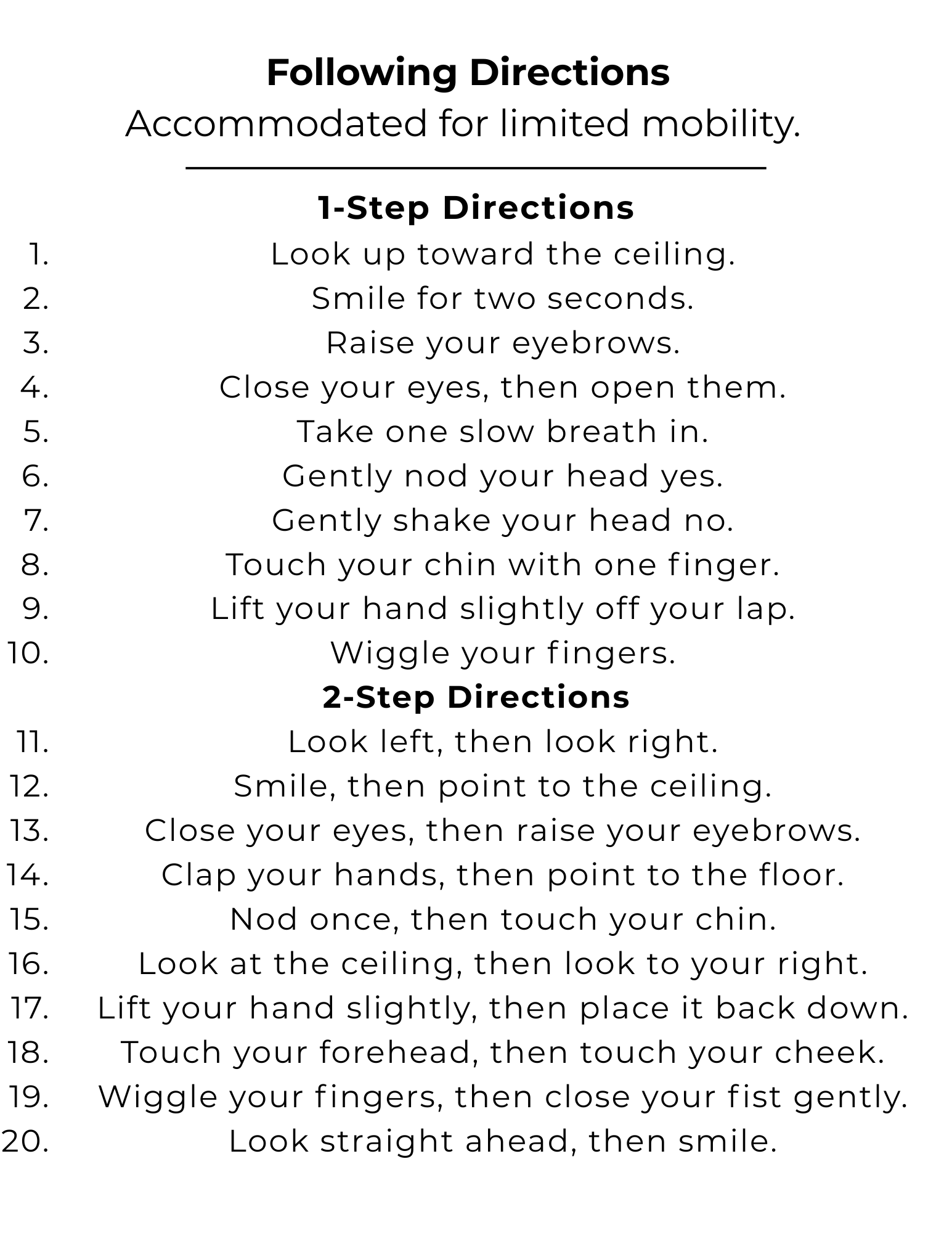
Following Directions
This worksheet provides 1-step and 2-step direction-following tasks designed for individuals with limited mobility. All actions can be completed while seated and focus on facial movements, small gestures, and gentle upper-body motions. The activity targets auditory comprehension, working memory, processing speed, and functional direction-following in a highly accessible format.
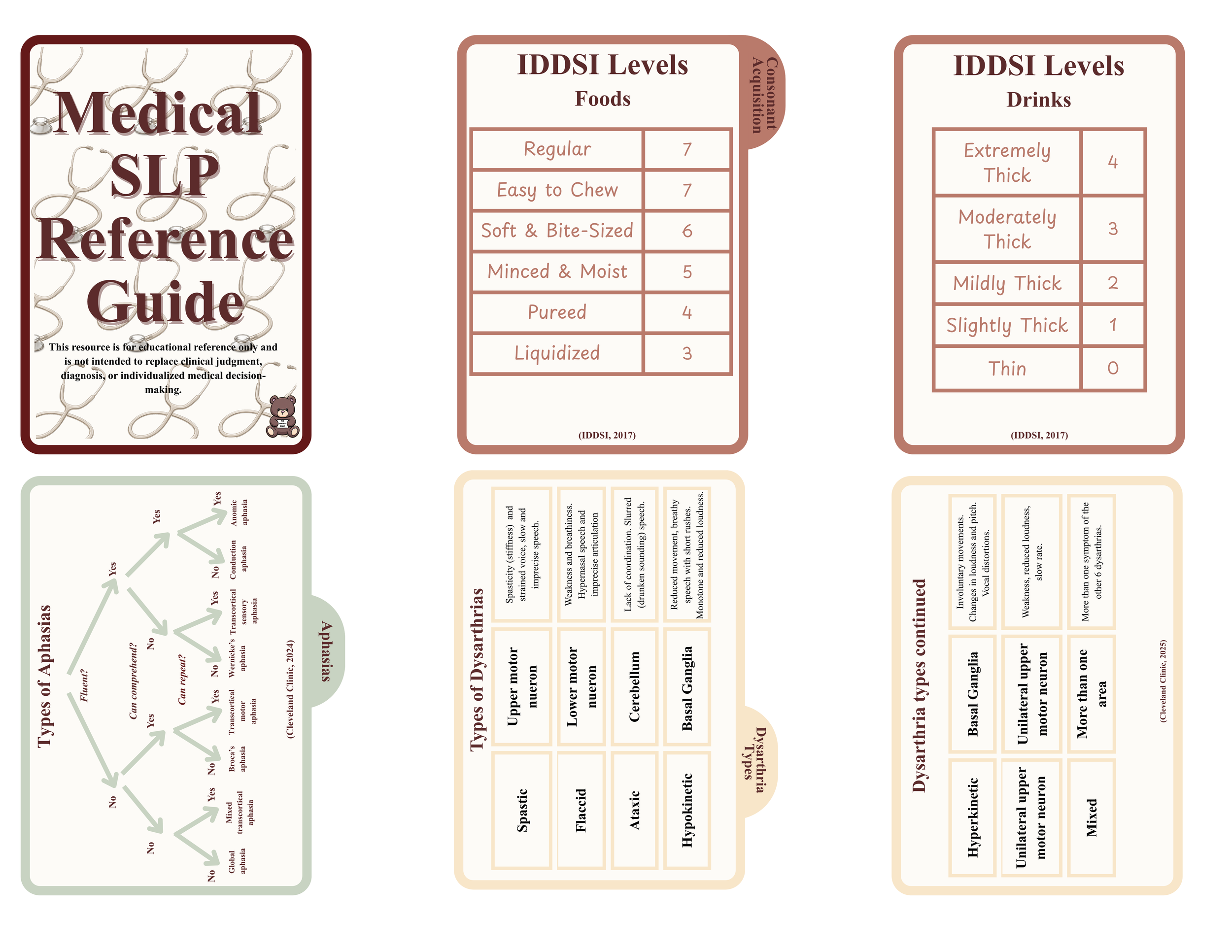
Medical SLP Reference Guide
This Medical SLP Reference Guide is a clean, aesthetic, and clinically grounded quick-reference resource designed for graduate students, clinical fellows, and practicing medical SLPs. Perfect for studying, clinical prep, and confidence-building in medical settings. The guide breaks down complex medical information into easy-to-scan visual charts while maintaining professional accuracy and clarity.
Miscellaneous
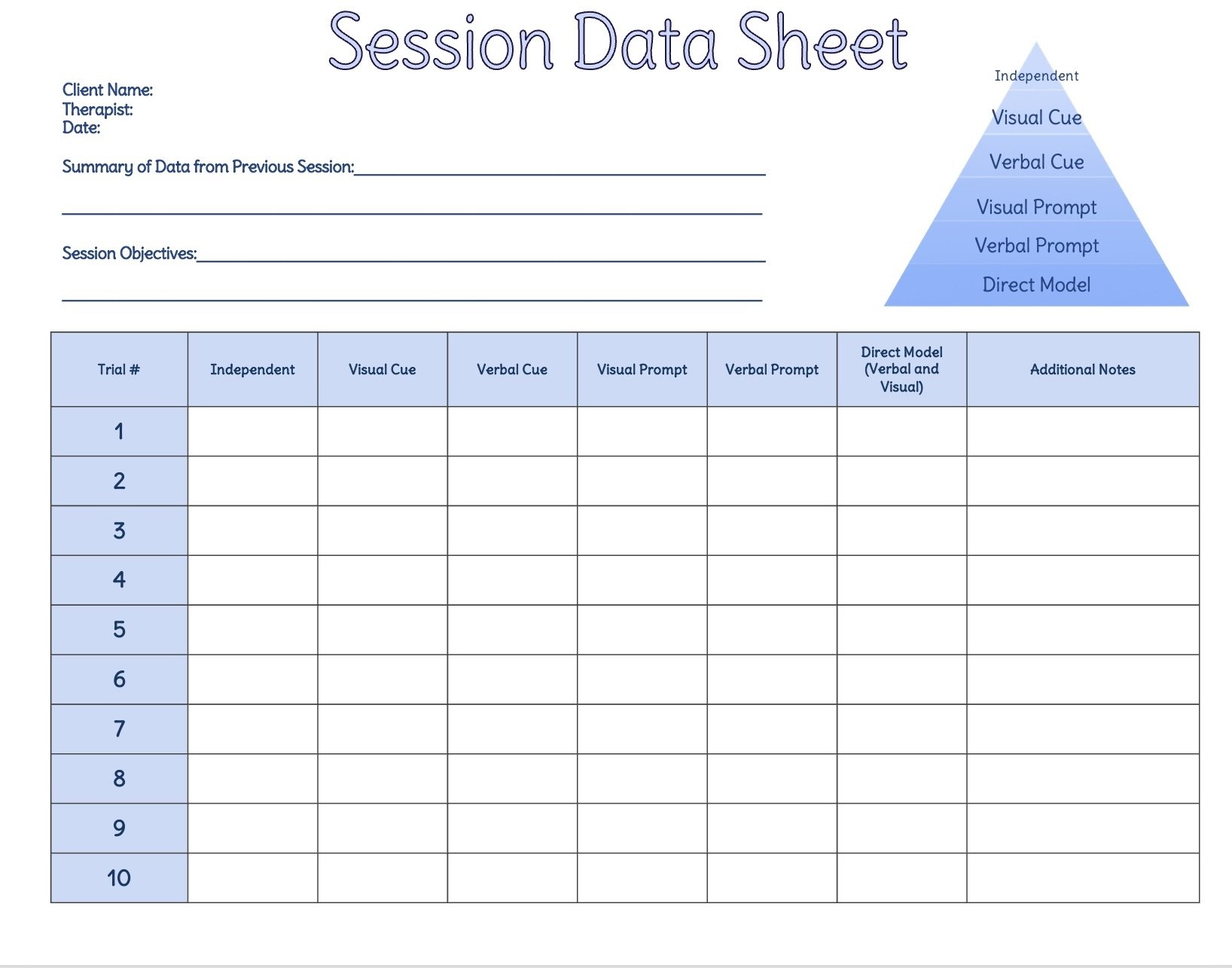
Data Sheet
Streamline your therapy sessions with this easy-to-use Data Sheet template. Designed for speech-language pathologists and graduate clinicians, this tool helps you track session objectives, prompts, cues, and client independence levels all in one place. Perfect for documenting progress across therapy sessions, it provides a clear structure for consistent note-taking and data collection.
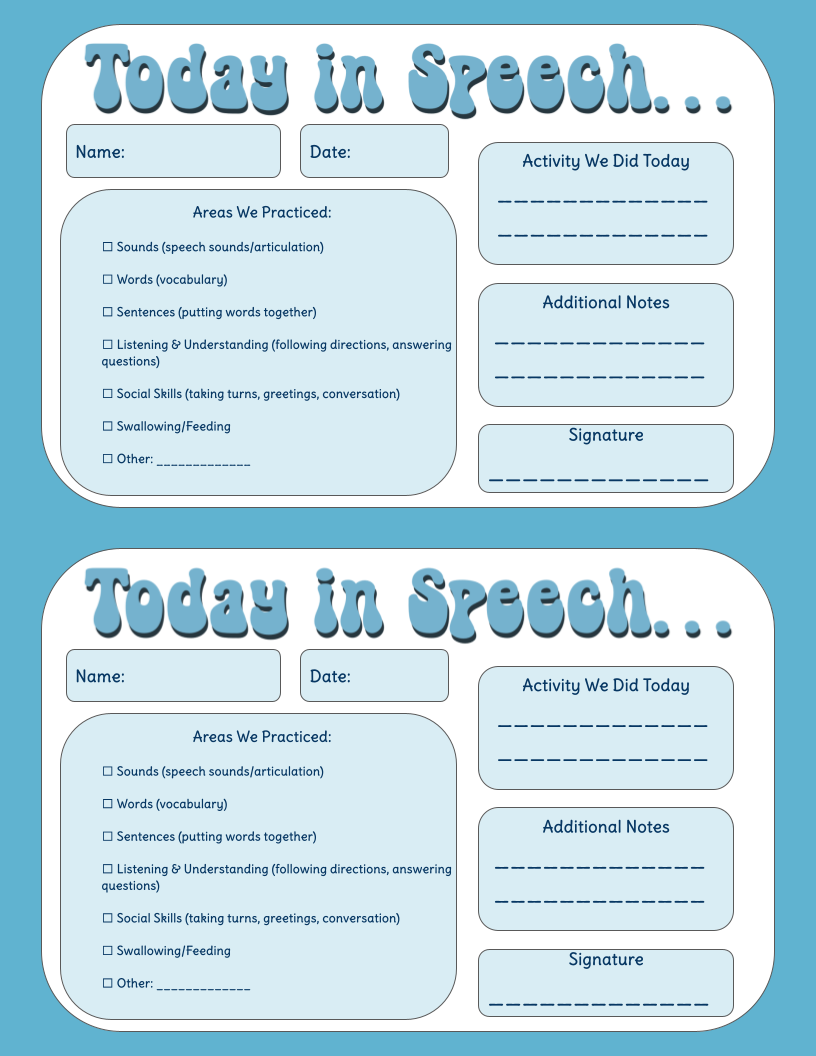
Take-Home Speech Sheet
This Take-Home Speech Sheet is a simple, effective way to keep parents informed and involved in their child’s progress. Therapists can quickly check off areas practiced (speech sounds, vocabulary, sentences, social skills, etc.), write in the day’s activity, add notes, and sign. Perfect for school or clinic use, it strengthens communication between home and therapy while providing families with clear updates.
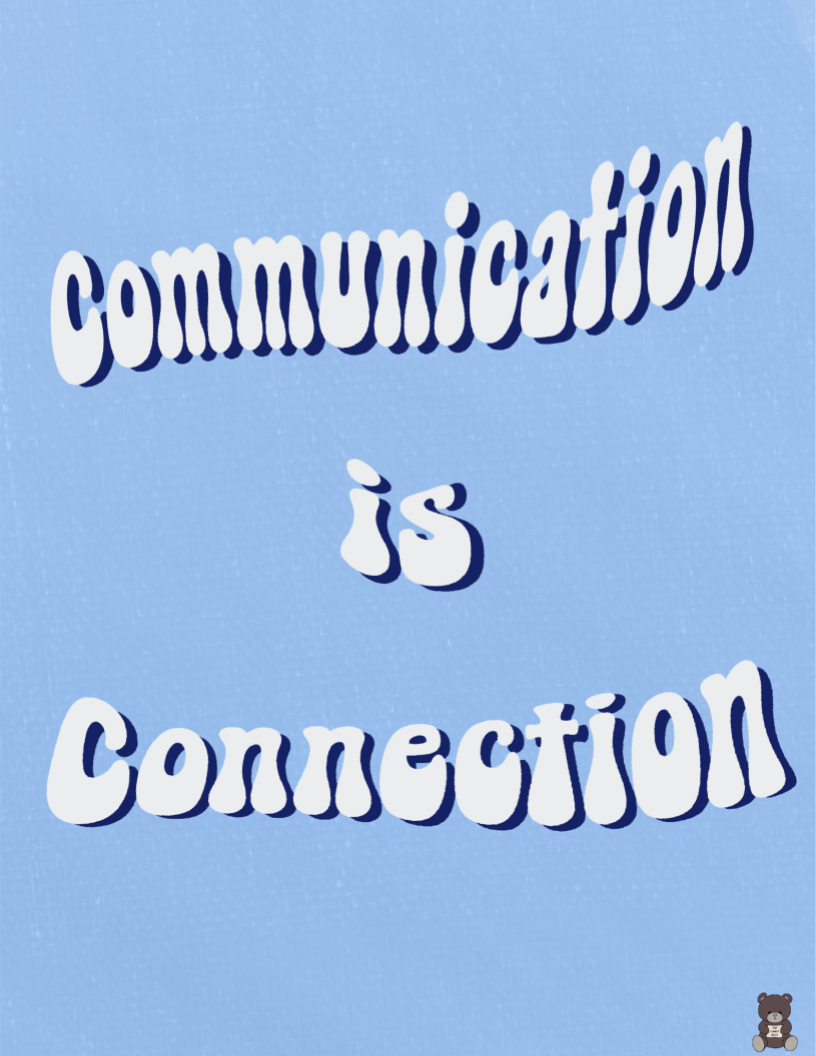
Printable: Communication is Connection
Add a touch of warmth and positivity to your space with this retro-inspired printable that reminds us all: Communication is Connection. Perfect for your therapy room, study corner, or home office, this design pairs calming blue tones with playful bubble lettering and a cozy bear icon. A simple but powerful reminder that words bring us closer together. 🐻💙
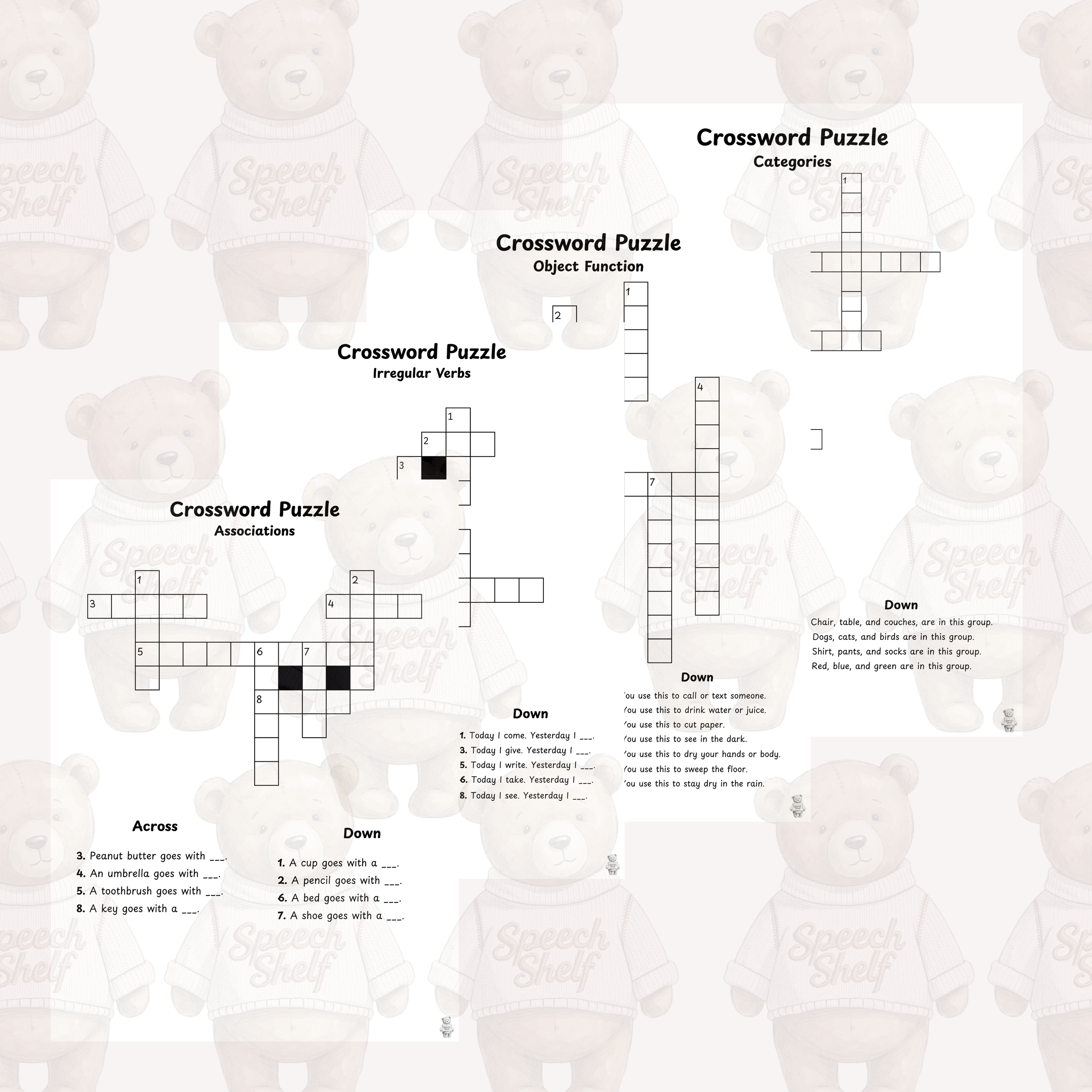
Crossword Puzzle Language Activities
This crossword puzzle set includes activities for categories, object functions, associations, and irregular verbs. Students use clues to fill in words while practicing vocabulary, reasoning, and language skills. The activities can be used for speech therapy, small groups, centers, or independent practice. An answer key is included to make checking work quick and easy. Great for pediatric and adult clients.
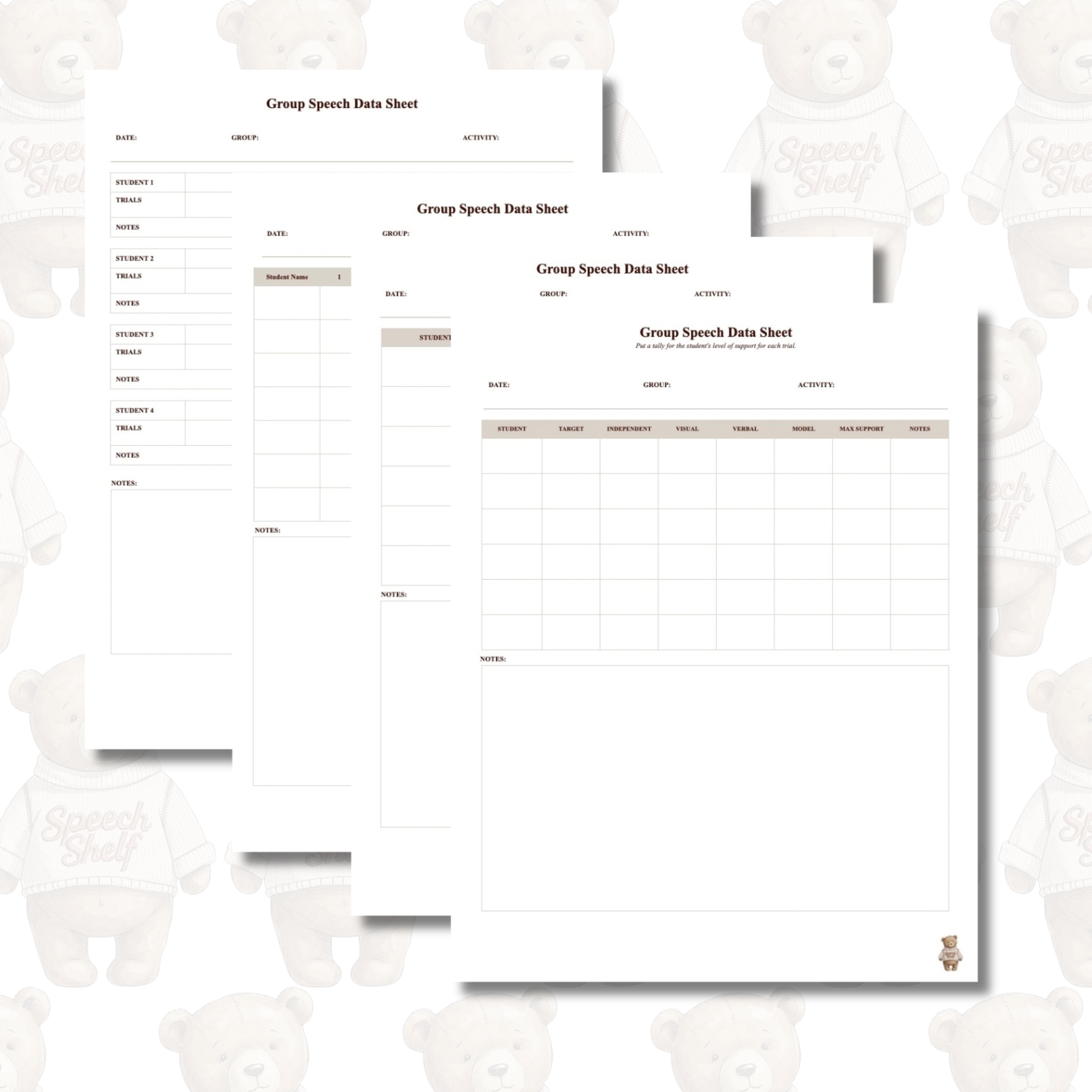
Group Data Sheets
Editable group speech data sheets designed to make data collection quick and organized. Includes 4 flexible formats for tracking goals, trials, prompts, accuracy, support levels, and notes.